Milk carton
Paper supplies stiffness; very thin layers supply barriers.
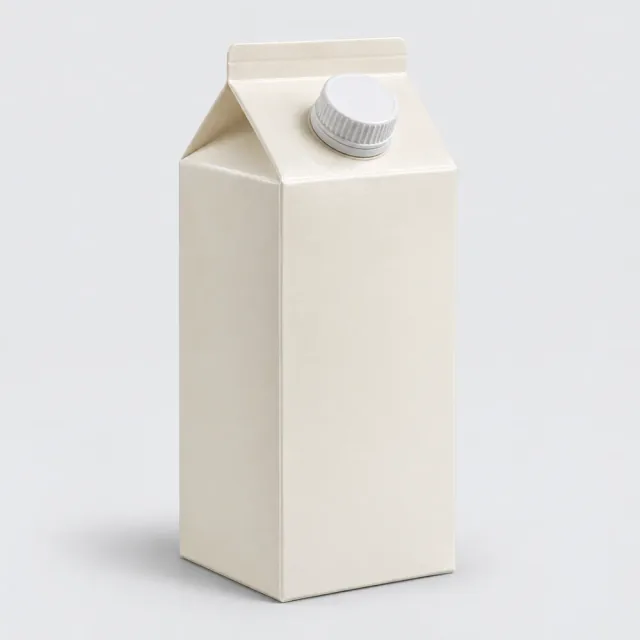
A beverage carton is a laminate, not simply a folded sheet of paper. Paperboard gives the package its shape, while polymer layers help contain liquid and resist moisture. An aseptic carton may add aluminium foil as a barrier to light and oxygen. This example describes that shelf-stable construction, including an optional screw closure. Refrigerated milk cartons commonly use a simpler structure and should not be assumed to contain aluminium.
Start with a part, then follow a material. No specialist knowledge needed.
Inside the object
Original conceptual illustration. Numbers open the component index; their positions are illustrative, not a disassembly guide. Equivalent text follows beside the diagram.
1Paperboard core
A relatively thick paperboard layer supplies stiffness and a printable surface with little mass. Its cellulose fibres carry much of the structural role but would not by themselves make a durable liquid container. The board is combined with barrier and sealing layers before the package is formed.
2Polymer layers
Polyethylene layers protect the board against moisture, provide a liquid-contact surface and help bond or seal the laminate. Different layers may serve different purposes even when they belong to the same polymer family. The carton works because the board and films act together, not because the board becomes waterproof paper by itself.
3Barrier foil
A thin aluminium layer in many aseptic cartons limits light and oxygen transmission. It is protected within the laminate rather than acting as a thick structural metal wall. A refrigerated carton may omit this layer because its intended storage system and shelf-life requirements are different.
4Closure
An optional moulded cap and neck allow the package to be opened and reclosed. Polyethylene and polypropylene are possible closure materials. Some cartons instead have a folded opening or other design. The closure is an additional assembly whose material and attachment affect both convenience and recycling.
Why these materials?
A carton splits functions across layers rather than demanding that one material do everything. Paperboard gives shape, polymers limit moisture and enable sealing, and foil can protect sensitive contents from light and oxygen. The same bonded structure that performs well in distribution is harder to separate after use. A paper mill equipped for cartons may recover fibres in water, leaving a polymer-and-aluminium fraction that needs its own destination. Recovering the fibres is useful but is not the same as recycling every layer. Collection and processing arrangements therefore matter as much as the word carton.
One object, many versions.
Refrigerated gable-top cartons often contain paperboard and polymer layers without aluminium. Aseptic packages may use foil or alternative barrier technologies, and caps are optional. Fibre and polymer proportions vary with design, size and manufacturer. Shelf stability also depends on food processing and filling conditions; packaging material alone does not make an opened carton or untreated contents shelf-stable.
What happens after use?
Check whether local collection specifically accepts beverage cartons rather than assuming all paper products are equivalent. Empty and prepare the carton as the service requests. At equipped mills, fibres can be separated from other layers, while the remaining fraction may undergo additional recovery or another treatment. A broad recyclable claim should not be read as proof that the complete carton is collected and fully recovered in every region.
Put the choices side by side.
Familiar things, connected.

Follow the evidence
Original explanations informed by the sources below. Technical and industry sources support material behaviour; industry environmental marketing is not treated as a universal comparison. Browse the source register.
- Carton packaging materials ↗Tetra Pak · Undated · Checked 2026-11-13
- Tetra Pak cartons: From used to useful again ↗Tetra Pak · Undated · Checked 2026-11-13
- About Pulp & Paper ↗Confederation of European Paper Industries · Undated · Checked 2026-11-13
- How Is Paper Made Today? ↗American Forest & Paper Association · 2025-05-01 · Checked 2026-11-13
- Polyethylene (Low Density) LDPE, LLDPE ↗British Plastics Federation · Undated · Checked 2026-11-13
- Plastics Processes ↗British Plastics Federation · Undated · Checked 2026-11-13
- Aluminum Production and Processing ↗The Aluminum Association · Undated · Checked 2026-11-13
- Mineral Commodity Summaries 2026 — Aluminum ↗U.S. Geological Survey, National Minerals Information Center · 2026-05-27 (version 1.3) · Checked 2026-11-13
- Polyethylene (High Density) HDPE ↗British Plastics Federation · Undated · Checked 2026-11-13
- How Do I Recycle Common Recyclables ↗U.S. Environmental Protection Agency · Undated · Checked 2026-11-13
- Polypropylene (PP) ↗British Plastics Federation · Undated · Checked 2026-11-13