Toothpaste and tube
A formulation and its container solve different problems.
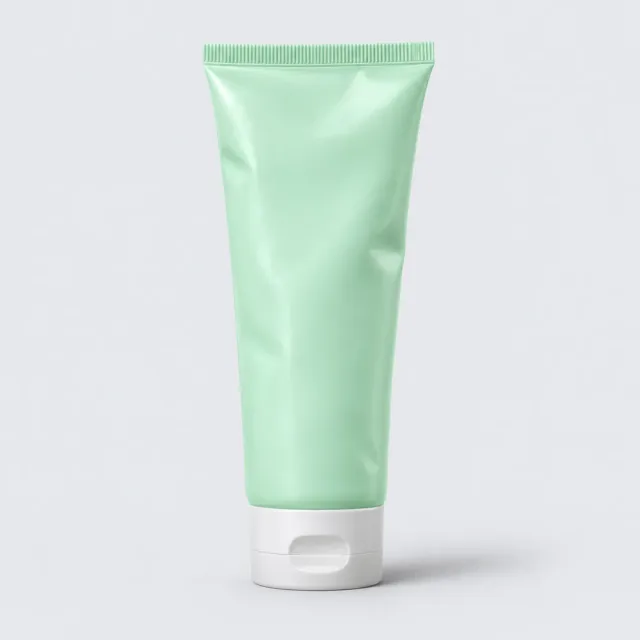
Toothpaste is a designed mixture held inside a designed package. An abrasive helps remove deposits and surface stains, while water, humectants and binders keep the paste usable. Many formulations include a fluoride compound for cavity prevention. The tube must resist leakage and let the paste be dispensed. This example separates the mixture from its packaging and shows common alternatives; it is not a recipe or a guide to choosing dental treatment.
Start with a part, then follow a material. No specialist knowledge needed.
Inside the object
Original conceptual illustration. Numbers open the component index; their positions are illustrative, not a disassembly guide. Equivalent text follows beside the diagram.
1Cleaning particles
Hydrated silica or calcium carbonate can act as an abrasive in a formulated toothpaste. Particle characteristics and the complete recipe affect behaviour; a mineral name alone does not specify abrasivity. These are representative alternatives, and a particular toothpaste does not necessarily contain both of them.
2Paste base and active ingredients
Water, humectants such as glycerol or sorbitol, binders, surfactants and flavourings perform different jobs. Fluoride compounds occur in many formulations. These ingredients are not fully represented in the material index, so no substitute material link is implied. The finished product must be evaluated as a formulation.
Composition explained here; no separate material entry in this edition.
3Flexible tube
Some modern tubes use an HDPE-rich construction designed for compatible recycling streams; other tubes have multiple polymers and an aluminium barrier. Flexible walls, seals and barrier performance must work together. A printed recycling claim therefore needs interpretation alongside the actual tube construction and local acceptance rules.
4Cap and outer box
A moulded polymer cap closes the outlet and may be polypropylene or polyethylene, depending on the package. An optional paperboard box carries information and protects the tube in distribution. These parts serve the package rather than contributing to the chemical action of the paste.
Why these materials?
The abrasive is only one part of toothpaste performance. A powder that cleans effectively in a controlled formulation cannot be assumed suitable for direct use on teeth. Humectants keep the paste from drying too quickly; binders help particles remain distributed; the container makes a measured quantity easy to dispense. Packaging design also creates a trade-off: combining different layers can improve barrier and handling properties, but makes material recovery harder. An HDPE-rich tube may simplify one part of recycling, yet it still needs a collection and sorting system willing to accept that shape.
One object, many versions.
Formulas differ in abrasive, fluoride compound and concentration, flavour, texture and intended use. Tubes can be plastic laminate, aluminium laminate or metal, and caps vary. Toothpaste tablets and pumps are different package systems with their own materials. An atlas material description cannot establish that a specific dental product is suitable for a particular person; use its label and professional guidance.
What happens after use?
Use the product according to its instructions rather than attempting to recover ingredients from the paste. Follow local guidance for the emptied tube and cap: resin compatibility is not proof that a service accepts toothpaste tubes. Paperboard outer boxes may have a separate collection route. Check the whole item, including residual contents and mixed layers, instead of treating the recycling symbol as a global disposal instruction.
Familiar things, connected.
Follow the evidence
Original explanations informed by the sources below. Technical and industry sources support material behaviour; industry environmental marketing is not treated as a universal comparison. Read our editorial method.
- Toothpastes ↗American Dental Association · Undated · Checked 2026-11-13
- Colgate’s Innovative Tube: Transforming the Landscape ↗Colgate-Palmolive · Undated · Checked 2026-11-13
- Consumer guide to plastic resin codes ↗PET Resin Association · Undated · Checked 2026-11-13
- Silica ↗Sibelco · Undated · Checked 2026-11-13
- Silica is safe — frequently asked questions ↗Evonik · Undated · Checked 2026-11-13
- Silica dust ↗UK Health and Safety Executive · Undated · Checked 2026-11-13
- Our Minerals ↗Omya · Undated · Checked 2026-11-13
- Oral Care Portfolio — Natural Calcium Carbonates ↗Omya · 2025 · Checked 2026-11-13
- Polyethylene (High Density) HDPE ↗British Plastics Federation · Undated · Checked 2026-11-13
- Plastics Processes ↗British Plastics Federation · Undated · Checked 2026-11-13
- How Do I Recycle Common Recyclables ↗U.S. Environmental Protection Agency · Undated · Checked 2026-11-13
- Polyethylene (Low Density) LDPE, LLDPE ↗British Plastics Federation · Undated · Checked 2026-11-13
- Aluminum Production and Processing ↗The Aluminum Association · Undated · Checked 2026-11-13
- Mineral Commodity Summaries 2026 — Aluminum ↗U.S. Geological Survey, National Minerals Information Center · 2026-05-27 (version 1.3) · Checked 2026-11-13
- Polypropylene (PP) ↗British Plastics Federation · Undated · Checked 2026-11-13
- About Pulp & Paper ↗Confederation of European Paper Industries · Undated · Checked 2026-11-13
- How Is Paper Made Today? ↗American Forest & Paper Association · 2025-05-01 · Checked 2026-11-13