Concrete block
A shaped mineral composite with strength in both its material and geometry.
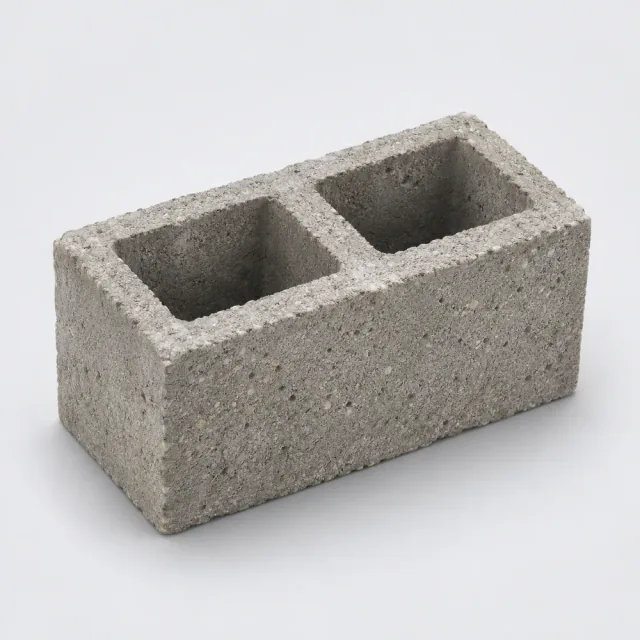
A concrete masonry block combines a cementitious binder with mineral aggregate and a deliberately shaped geometry. Hollow units use face shells and connecting webs to provide useful structure without filling the entire outline with concrete. This representative unreinforced hollow block is examined at two scales: its structural regions and its material constituents. It is one moulded composite, not four separate components glued together after manufacture.
Start with a part, then follow a material. No specialist knowledge needed.
Inside the object
Original conceptual illustration. Numbers open the component index; their positions are illustrative, not a disassembly guide. Equivalent text follows beside the diagram.
1Face shells
The outer walls of a hollow block are concrete face shells. They form the visible surfaces and carry loads as part of the designed unit and wall. Their thickness, shape and condition matter; a hollow block is not simply a solid brick with arbitrary material removed from the middle.
2Connecting webs
Concrete webs connect the face shells and help the unit retain its shape and distribute loads. The resulting voids reduce the amount of material in the unit and can serve functions within a specified masonry design. They are empty spaces, not an additional solid material hidden in the block.
3Hardened binder
Cement mixed with water reacts through hydration to produce the binding phases around the aggregate. The cement entry describes the starting binder material; the cured block contains its reaction products and any remaining unreacted particles. Hardening is therefore not simply water evaporating from a paste of unchanged powder.
4Mineral aggregate
Sand and larger or lightweight aggregate form much of the block’s mineral skeleton. Quartz-rich sand and crushed limestone are possible constituents, represented by silica and calcium carbonate, but local geology and product design vary. Not every block contains both, and manufactured lightweight aggregates have different compositions.
Why these materials?
Concrete and cement answer different questions. Cement identifies a reactive binder; concrete identifies a composite made by combining that binder system with aggregate and water. A masonry block adds another level: a manufactured shape with face shells, webs and controlled dimensions. The holes can reduce weight and allow particular wall constructions, but they also make load paths important. Mix design, compaction and curing influence the unit’s properties before it reaches a building site. Once assembled, mortar, reinforcement where specified, connections and workmanship determine the wall’s performance alongside the individual block’s tested characteristics.
One object, many versions.
Solid, hollow, lightweight and architectural concrete masonry units serve different purposes. Pigments, textured faces and varied aggregates can alter appearance without changing the basic composite principle. “Cinder block” is sometimes used loosely, but modern units need not contain coal cinders. Aerated concrete is a different product system and should not be treated as an interchangeable block of the same geometry.
What happens after use?
Sound salvaged units may be useful in an appropriate project after condition and suitability are assessed; structural reuse needs competent design judgment. Broken concrete can sometimes be processed into aggregate, but this does not regenerate the original cement binder. Acceptance depends on contamination and local facilities. Cutting or crushing can release hazardous dust, so processing should use appropriate professional controls and established recovery services.
Familiar things, connected.


Follow the evidence
Original explanations informed by the sources below. Technical and industry sources support material behaviour; industry environmental marketing is not treated as a universal comparison. Read our editorial method.
- Concrete Masonry Unit Shapes, Sizes, Properties and Specifications ↗Concrete Masonry & Hardscapes Association · Undated · Checked 2026-11-13
- What is the difference between a cinder block and a concrete block? ↗Concrete Masonry & Hardscapes Association · Undated · Checked 2026-11-13
- About Concrete ↗National Ready Mixed Concrete Association · Undated · Checked 2026-11-13
- Explained: Cement vs. concrete — their differences, and opportunities for sustainability ↗MIT Concrete Sustainability Hub; Andrew Logan · 2020-04-03 · Checked 2026-11-13
- Cement & Concrete FAQ ↗American Cement Association · Undated · Checked 2026-11-13
- Sustainable Management of Construction and Demolition Materials ↗U.S. Environmental Protection Agency · Undated · Checked 2026-11-13
- The making of portland cement ↗American Concrete Institute · Undated · Checked 2026-11-13
- How Cement Is Made ↗American Cement Association · Undated · Checked 2026-11-13
- Silica ↗Sibelco · Undated · Checked 2026-11-13
- Silica is safe — frequently asked questions ↗Evonik · Undated · Checked 2026-11-13
- Silica dust ↗UK Health and Safety Executive · Undated · Checked 2026-11-13
- Our Minerals ↗Omya · Undated · Checked 2026-11-13
- Oral Care Portfolio — Natural Calcium Carbonates ↗Omya · 2025 · Checked 2026-11-13