Ceramic tile floor
A hard surface relies on the layers beneath it.
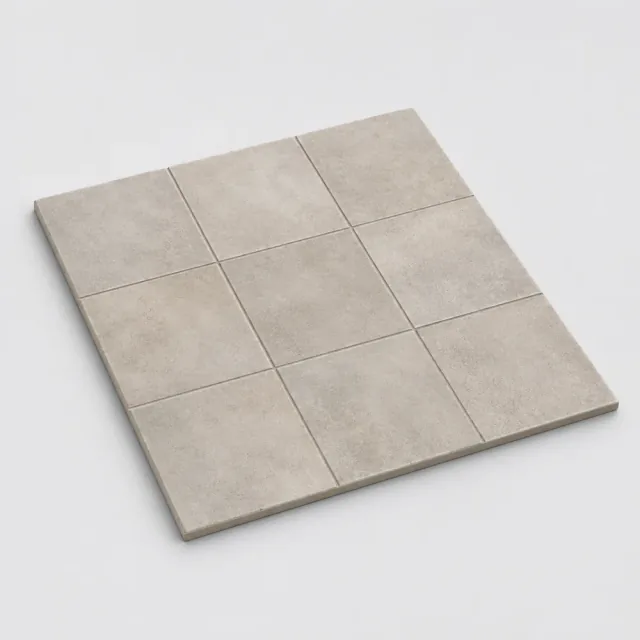
A ceramic tile floor is an assembly rather than a sheet of one material. Fired tiles provide the wear surface, but adhesive mortar, grout, joints and a stable substrate allow them to work as a floor. This representative glazed floor uses ceramic tiles bonded over concrete. Tile type, slip performance, moisture conditions and movement requirements determine the appropriate construction; a durable tile cannot compensate for an unsuitable supporting system.
Start with a part, then follow a material. No specialist knowledge needed.
Inside the object
Original conceptual illustration. Numbers open the component index; their positions are illustrative, not a disassembly guide. Equivalent text follows beside the diagram.
1Tile bodies
Porcelain and stoneware tile bodies are fired mineral mixtures, not slabs of dried clay. Their composition and firing create a combination of crystalline and glassy phases. Water absorption, strength and intended application vary, so a wall tile or a visually similar decorative tile is not automatically a floor tile.
2Glazed surface
A fired glaze forms a glass-rich surface bonded to the ceramic body. Silica and alumina are important constituents of many glaze formulations, chemically incorporated into the fired coating rather than sprinkled on as loose powders. Glaze texture and product testing influence traction and wear performance alongside the underlying tile.
3Bonding mortar
A cement-based thin-set mortar can bond tiles to the prepared substrate. Cement reacts with water to form a hardened binder around mineral grains; polymer modifiers may also be present. The installed layer is no longer dry cement powder, and mortar selection must match the tile and service conditions.
4Grout joints
Cementitious grout fills the narrow spaces between tiles and supports cleanable edges. It contains a hydrated binder and mineral ingredients whose formulation varies. Grout is distinct from the adhesive beneath the tile and should not be assumed to make an entire floor assembly waterproof.
5Supporting slab
A concrete slab supplies broad support beneath the tile system. Its own shrinkage, cracking, moisture and movement influence the finish above it. Concrete is a composite containing aggregate and cementitious paste; it is not synonymous with cement, and even a strong slab needs appropriate preparation and detailing.
6Movement joints
Flexible sealants, including suitable silicone products, can occupy designated movement joints where rigid grout would restrain necessary movement. Their placement and specification belong to the floor design. A soft joint is therefore an intentional feature, not simply a gap that was left unfinished or an interchangeable substitute for all grout.
Why these materials?
The visible hardness of tile hides a dependence on support. A brittle tile can resist surface abrasion while still cracking if it bends over a void or follows movement beneath it. The bonding layer distributes loads and joins the surfaces; joints accommodate geometry and, in designated places, movement. Moisture management may require additional layers that are not shown in this dry-interior example. Firing gives the tile a long-lived mineral body, but replacing a bonded tile can damage neighbouring work. Specifying the whole assembly well can therefore matter more to service life than choosing the hardest-looking surface.
One object, many versions.
Unglazed tiles expose the fired body directly, while glass, stone and cement tiles are different material systems. Epoxy grout changes the binder chemistry, and some floors use uncoupling or waterproofing membranes. Porcelain is a ceramic category rather than the opposite of ceramic. Suitability for wet, outdoor or freezing conditions must come from the specified product and assembly.
What happens after use?
A maintained floor can remain useful for a long time, and spare matching tiles may make local repairs possible. Intact salvaged tiles sometimes find reuse, but strongly bonded mortar makes separation difficult. Demolition material may be accepted as mineral aggregate feedstock where facilities permit it. Cutting and breaking can generate hazardous mineral dust, so removal and processing require appropriate professional controls rather than casual indoor grinding.
Familiar things, connected.

Follow the evidence
Original explanations informed by the sources below. Technical and industry sources support material behaviour; industry environmental marketing is not treated as a universal comparison. Read our editorial method.
- Tile: The Natural Choice ↗Tile Council of North America · 2025 · Checked 2026-11-13
- North American Cement Grout for Tile Installation: Environmental Product Declaration ↗Tile Council of North America · 2022-12-15 · Checked 2026-11-13
- Thinsets: Planning a Job ↗LATICRETE · Undated · Checked 2026-11-13
- Holistic health: How ceramics and glass contribute to our physical and mental wellbeing ↗The American Ceramic Society · Undated · Checked 2026-11-13
- Rivalry and Dresden plates and quilts: European porcelain production ↗The American Ceramic Society · Undated · Checked 2026-11-13
- Quality of recycling: Towards a reference framework for the circular economy ↗European Commission Joint Research Centre · 2020 · Checked 2026-11-13
- Stoneware ↗Digitalfire, ceramic materials technical reference · Undated · Checked 2026-11-13
- Islamic Ceramics: Glossary N–Z ↗Ashmolean Museum, University of Oxford · Undated · Checked 2026-11-13
- Sustainable Management of Construction and Demolition Materials ↗U.S. Environmental Protection Agency · Undated · Checked 2026-11-13
- Silica ↗Sibelco · Undated · Checked 2026-11-13
- Silica is safe — frequently asked questions ↗Evonik · Undated · Checked 2026-11-13
- Silica dust ↗UK Health and Safety Executive · Undated · Checked 2026-11-13
- Advanced Ceramic Substrates for Electronic Applications ↗CeramTec · Undated · Checked 2026-11-13
- Aluminum Production and Processing ↗The Aluminum Association · Undated · Checked 2026-11-13
- The making of portland cement ↗American Concrete Institute · Undated · Checked 2026-11-13
- How Cement Is Made ↗American Cement Association · Undated · Checked 2026-11-13
- Explained: Cement vs. concrete — their differences, and opportunities for sustainability ↗MIT Concrete Sustainability Hub; Andrew Logan · 2020-04-03 · Checked 2026-11-13
- Cement & Concrete FAQ ↗American Cement Association · Undated · Checked 2026-11-13
- Room Temperature Vulcanizing (RTV) Silicones: Material and Processing Guidelines ↗WACKER Chemie · Undated · Checked 2026-11-13
- Products & Services — Annual Report 2025 ↗WACKER Chemie · 2026 (report for 2025) · Checked 2026-11-13