Soap dispenser
A small pump turns a hand movement into controlled liquid flow.
A manual soap dispenser pairs a container with a compact pump containing moving seals, flow passages and a return mechanism. This representative assembly uses a PET bottle, polypropylene pump body, polyethylene piston and stainless-steel spring. The bottle and pump are separate engineering problems, and a decorative exterior reveals little about the hidden mechanism. All-plastic pumps and other bottle materials also exist, so this is not a single universal parts list.
Start with a part, then follow a material. No specialist knowledge needed.
Inside the object
Original conceptual illustration. Numbers open the component index; their positions are illustrative, not a disassembly guide. Equivalent text follows beside the diagram.
1Refillable bottle
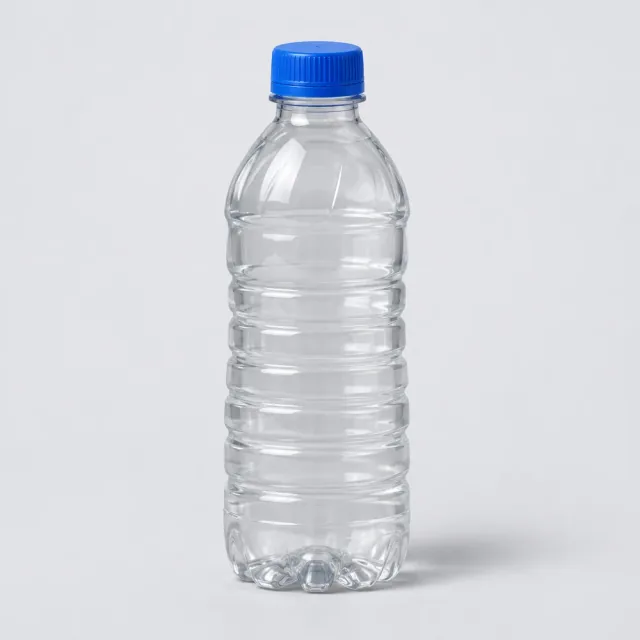
A PET bottle can provide a lightweight, clear container with a formed neck for the pump closure. Stretch blow moulding is an established manufacturing route. Compatibility still depends on the intended contents, neck dimensions and closure, not merely on the bottle being transparent.
2Actuator and pump housing
The moulded actuator transfers finger force into the mechanism, while the housing contains the pumping chamber and flow paths. Polypropylene is a documented option for these parts. The small outlet must work with the liquid's flow behaviour; a pump designed for lotion may not suit every soap formulation.
3Moving piston seal
A compliant polyethylene piston slides within the chamber while maintaining the seal needed to displace liquid. LDPE is one documented construction choice. A worn or poorly matched seal can allow leakage past the piston, reducing the useful dose even when the actuator still moves.
4Return spring
A stainless-steel spring restores the actuator after it is pressed, preparing the pump for another stroke. Spring location varies, and some designs keep it outside the liquid path. Stainless steel improves corrosion resistance but does not make every pump compatible with every chemical formulation.
5Dip tube and check-valve path
A dip tube carries liquid from near the bottle bottom to the pump, while valves guide flow in the required direction. Polypropylene is one documented tube option; other pumps use polyethylene. Valve parts may include other polymers, glass or metal, which are not automatically the same material as the tube.
Why these materials?
A pump works by changing chamber volume and controlling the direction in which liquid can move. Pressing the actuator displaces a dose; returning the actuator allows the chamber to refill through the inlet path. The first strokes may move air before liquid reaches the outlet. Seals and valves are therefore as important as the visible nozzle. An apparently simple dispenser can contain several polymers and a spring, explaining why replacing a failed compatible pump may be more practical than discarding an undamaged bottle.
One object, many versions.
Some pumps are designed entirely from polyolefins, while others contain a metal spring and small glass or metal valve parts. Foaming dispensers add an air-mixing system and require suitable contents. Bottles can be glass, ceramic or other polymers. A pump's threaded fit alone does not prove that its dip-tube length, dose or materials suit a replacement container.
What happens after use?
Refill and clean only as the dispenser and soap maker direct, and avoid mixing incompatible contents. A compatible replacement pump may keep a sound bottle in use. For disposal, check whether the local programme wants the pump removed: small mixed-material mechanisms can have a different route from bottles. Do not assume an all-plastic pump is accepted everywhere.
Familiar things, connected.
Follow the evidence
Original explanations informed by the sources below. Technical and industry sources support material behaviour; industry environmental marketing is not treated as a universal comparison. Read our editorial method.
- 500 ml Soap Dispenser Bottle 28/410 ↗ALPLA · Undated · Checked 2026-11-14
- Lotion Pumps — Digital Catalogue 2024 ↗Aptar Beauty; manufacturer catalogue hosted by Alglass · 2024 · Checked 2026-11-14
- Inside vs Outside Spring Lotion Pumps ↗NuoBang Packaging · 2026-10-26 · Checked 2026-11-14
- GSA Advance ↗Aptar Beauty · Undated · Checked 2026-11-14
- Polyesters (Thermoplastic) PETP, PBT, PET ↗British Plastics Federation · Undated · Checked 2026-11-13
- Plastics Processes ↗British Plastics Federation · Undated · Checked 2026-11-13
- The Facts about PET ↗Dr Frank Welle; Petcore Europe · 2018 · Checked 2026-11-13
- Polypropylene (PP) ↗British Plastics Federation · Undated · Checked 2026-11-13
- Polyethylene (Low Density) LDPE, LLDPE ↗British Plastics Federation · Undated · Checked 2026-11-13
- General principles for selection of stainless steels ↗British Stainless Steel Association · Undated · Checked 2026-11-13
- Recycling ↗worldstainless · Undated · Checked 2026-11-13