Silk scarf
A protein fibre becomes a surface that catches light and folds easily.
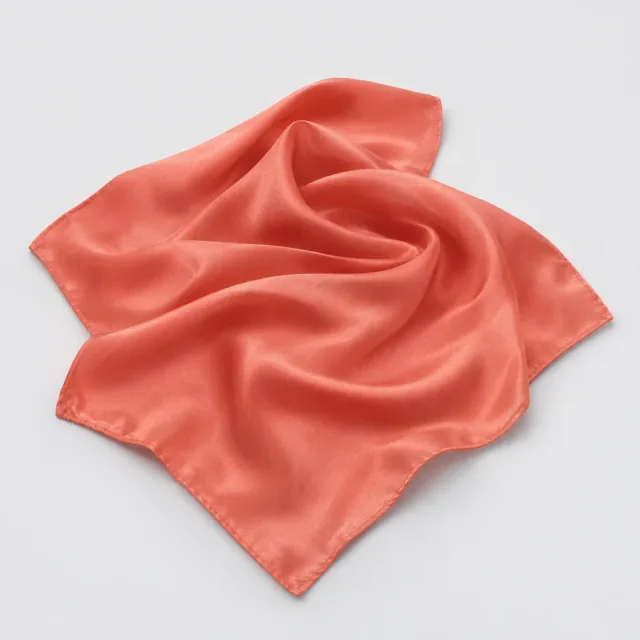
A silk scarf can be materially simple and structurally subtle. Woven silk forms the cloth, a finished edge prevents fraying, and printed or dyed colour changes its appearance without creating a separate structural sheet. This representative square twill scarf has rolled edges and a sewn care label. Its components include regions of the same fabric rather than implying that every visible feature introduces a different raw material.
Start with a part, then follow a material. No specialist knowledge needed.
Inside the object
Original conceptual illustration. Numbers open the component index; their positions are illustrative, not a disassembly guide. Equivalent text follows beside the diagram.
1Woven cloth
Silk yarns interlace to form a thin fabric that can drape and fold. The fibre is protein-based, unlike the cellulose of cotton or flax. A twill weave produces diagonal surface features, while yarn size, twist and finishing influence the hand and lustre alongside the fibre’s own structure.
2Rolled edge
The perimeter can be rolled and secured so that the cut edge is enclosed. This is a shaped part of the same silk cloth, not a different material added to the scarf. The narrow hem controls fraying while limiting the stiffness that a broad, heavy edge would introduce.
3Hem stitching
Fine thread holds the rolled hem in position through repeated folding and handling. Silk thread is one option, while other scarves use polyester or another sewing thread. The label for the main fabric does not necessarily describe every small sewing component, so the thread composition is presented as a variant.
4Colour and print
Dyes can colour the fibres, while printing places colour in a designed pattern. The colorants and processing auxiliaries vary and are not a single indexed material here. Lightfastness and response to cleaning depend on the particular dye and finish, not simply on the fact that the cloth is silk.
Composition explained here; no separate material entry in this edition.
5Care label
A small woven polyester label is one possible carrier for fibre content and care instructions. Labels may use other textiles or be omitted in some products. Its purpose is informational, and its advice must be read for the finished scarf because dyes, hems and surface finishes also affect suitable cleaning.
Why these materials?
The scarf’s movement comes from many levels of structure. Flexible fibres become yarns; yarns can shift slightly within a weave; the whole cloth then bends into folds. Lustre depends on how light interacts with the fibres and the arrangement of the fabric, so a shiny appearance is not a chemical identification test. Edge finishing preserves that fluid behaviour while preventing loose yarns from escaping. Colour adds another set of constraints: a durable fibre can still carry a light-sensitive dye. The best care decision therefore follows the complete textile’s requirements rather than a general claim that natural fibres are always easy to wash.
One object, many versions.
Satin, chiffon and twill describe fabric structures or types, not different animal sources of silk. Scarves can blend silk with wool, cotton or other fibres. Some use fringed or machine-stitched edges rather than rolled hems. A silk-like sheen can also come from synthetic fibres, so appearance alone cannot establish a scarf’s fibre content.
What happens after use?
Careful storage, limited unnecessary cleaning and mending a loosened hem can extend a scarf’s useful life. Follow the finished article’s care label, since colour and finishing may be more sensitive than the fibre alone. A wearable scarf can be passed on. Textile collection must explicitly accept it; a biological origin does not make dyed, finished and labelled cloth automatically suitable for household composting.
Familiar things, connected.
Cotton T-shirt
Plant fibres become yarn, then a flexible looped fabric.
Fleece jacket
A familiar bottle polymer, rearranged into warmth.
Backpack
A flexible container with a hidden load path.
Follow the evidence
Original explanations informed by the sources below. Technical and industry sources support material behaviour; industry environmental marketing is not treated as a universal comparison. Read our editorial method.
- Selle en Eclats scarf 90 ↗Hermès · Undated · Checked 2026-11-13
- Basic care — Textiles ↗Canadian Conservation Institute · Undated · Checked 2026-11-13
- Project Interwoven: studying textiles from the outside in ↗Victoria and Albert Museum · Undated · Checked 2026-11-13
- Silk reeling and testing manual — Chapter 1: Introduction ↗Food and Agriculture Organization of the United Nations · Undated · Checked 2026-11-13
- Silk reeling and testing manual — Chapter 2: Characteristics of the cocoon ↗Food and Agriculture Organization of the United Nations · Undated · Checked 2026-11-13
- Caring for textiles and costumes — Preventive conservation guidelines for collections ↗Canadian Conservation Institute · Undated · Checked 2026-11-13
- Polyesters (Thermoplastic) PETP, PBT, PET ↗British Plastics Federation · Undated · Checked 2026-11-13
- Melt Spinning ↗Textile Exchange · Undated · Checked 2026-11-13
- Microplastics from textiles: towards a circular economy for textiles in Europe ↗European Environment Agency · 2022 · Checked 2026-11-13