Running shoe
A hard-wearing surface, a soft middle, a flexible shell.
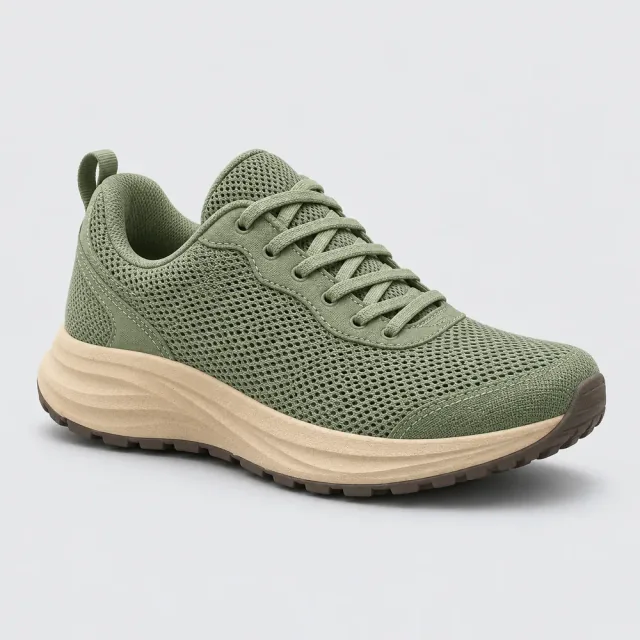
A running shoe combines materials that behave very differently under load. The upper holds and ventilates the foot. A foam midsole compresses and recovers, while a tougher outsole faces repeated contact with the ground. Laces, seams, adhesives and lining complete the assembly. This example uses an EVA-based midsole and textile upper; many contemporary shoes use other foam formulations, so it should not be read as a particular model’s construction.
Start with a part, then follow a material. No specialist knowledge needed.
Inside the object
Original conceptual illustration. Numbers open the component index; their positions are illustrative, not a disassembly guide. Equivalent text follows beside the diagram.
1Textile upper
Polyester or nylon yarns can be knitted or woven into an upper with selected stretch and ventilation. Reinforced areas help secure the foot while more open areas allow airflow. Fibre choice matters, but the textile pattern, coatings and seam placement also determine how the upper behaves.
2Foam midsole
EVA can be expanded into a cellular foam that compresses under load and recovers after release. The gas-filled structure gives cushioning at a lower mass than a solid polymer block. Foam density, cell structure and formulation influence feel and ageing; the name EVA does not specify a single performance level.
3Outsole
Rubber compounds provide the ground-contact surface, often with reinforcing fillers such as silica or carbon black. Natural rubber may be blended with synthetic rubbers. Tread shape and compound formulation affect grip and wear together, so the outsole is not simply a sheet of unmodified tree latex.
4Sockliner, seams and bonds
A removable foam sockliner can cushion and shape the interior. Polyester thread joins textile regions, while adhesives bond many soles to uppers. Polyurethane is one possible foam or adhesive family. These interfaces make a flexible assembly practical but complicate clean separation of material fractions later.
Why these materials?
Each step asks different parts of a shoe to do different things. An outsole that wore like a soft midsole would fail quickly; an upper made as rigid as the outsole would fit poorly. Cellular foam changes the response of the underlying polymer by introducing empty space. The result is a composite object even when it contains no carbon-fibre plate. Its performance depends on geometry, fit and the complete construction, rather than one ingredient. Bonding improves manufacturing and load transfer while making component replacement and material sorting more difficult.
One object, many versions.
Foams may use polyurethane, expanded thermoplastic polyurethane, polyether block amide or proprietary blends rather than EVA. Some shoes include carbon-fibre composite or polymer plates. Trail outsoles, track spikes and minimalist shoes have different priorities. Material names do not determine which shoe is suitable for a particular runner, and this overview does not imply an injury-prevention or performance guarantee.
What happens after use?
Keep usable shoes in circulation when they remain fit for their intended purpose. Repairability depends on the construction and available repair services; a worn outsole does not always mean an upper can be economically recovered. Specialist footwear take-back programmes may separate or shred materials, but are not available everywhere. Shoes should not be placed into ordinary plastic packaging collection simply because most components are polymers.
Familiar things, connected.
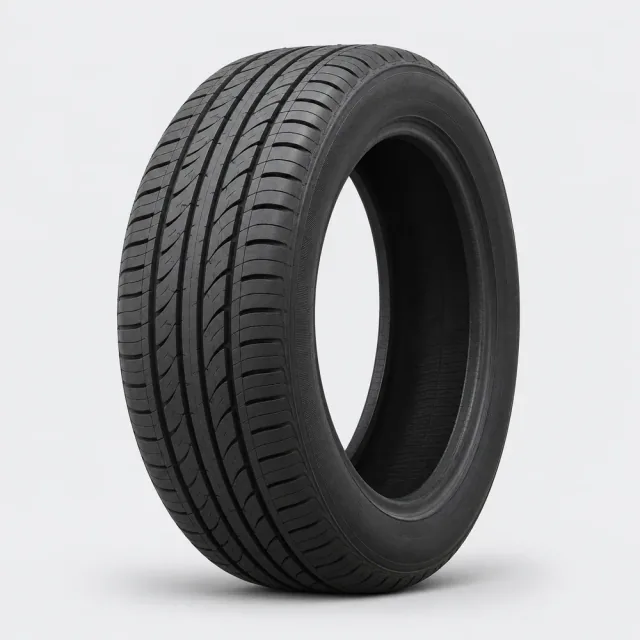
Car tyre
A reinforced pressure vessel that must keep flexing.
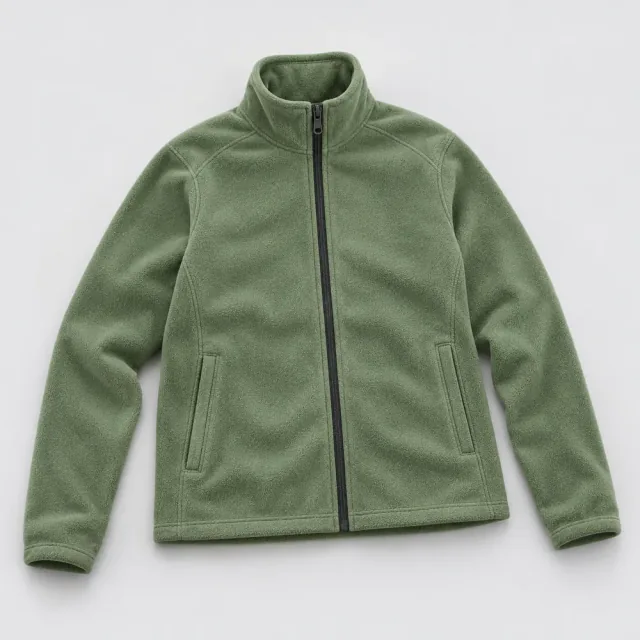
Fleece jacket
A familiar bottle polymer, rearranged into warmth.

Bicycle
Strength depends on shape as well as substance.
Follow the evidence
Original explanations informed by the sources below. Technical and industry sources support material behaviour; industry environmental marketing is not treated as a universal comparison. Browse the source register.
- The anatomy of a running shoe ↗ASICS · Undated · Checked 2026-11-13
- What is FLYTEFOAM? ↗ASICS · Undated · Checked 2026-11-13
- Materials: Basic knowledge of tires ↗Bridgestone · Undated · Checked 2026-11-13
- Polyesters (Thermoplastic) PETP, PBT, PET ↗British Plastics Federation · Undated · Checked 2026-11-13
- Melt Spinning ↗Textile Exchange · Undated · Checked 2026-11-13
- Microplastics from textiles: towards a circular economy for textiles in Europe ↗European Environment Agency · 2022 · Checked 2026-11-13
- Nylons (Polyamide) ↗British Plastics Federation · Undated · Checked 2026-11-13
- Ethylene Vinyl Acetate EVA ↗British Plastics Federation · Undated · Checked 2026-11-13
- Solar Photovoltaic Manufacturing Basics ↗U.S. Department of Energy · Undated · Checked 2026-11-13
- Solar Photovoltaics Supply Chain Deep Dive Assessment ↗U.S. Department of Energy · 2022-02-24 · Checked 2026-11-13
- Natural Rubber at a glance ↗Michelin · Undated · Checked 2026-11-13
- Introduction to rubber processing and safety issues ↗UK Health and Safety Executive · Undated · Checked 2026-11-13
- Silica ↗Sibelco · Undated · Checked 2026-11-13
- Silica is safe — frequently asked questions ↗Evonik · Undated · Checked 2026-11-13
- Silica dust ↗UK Health and Safety Executive · Undated · Checked 2026-11-13
- Frequently asked questions on polyurethanes ↗ISOPA / Polyurethanes.org · Undated · Checked 2026-11-13
- The chemistry of polyurethanes ↗Danielle Williams, Lawrence Industries · Undated · Checked 2026-11-13