Car tyre
A reinforced pressure vessel that must keep flexing.
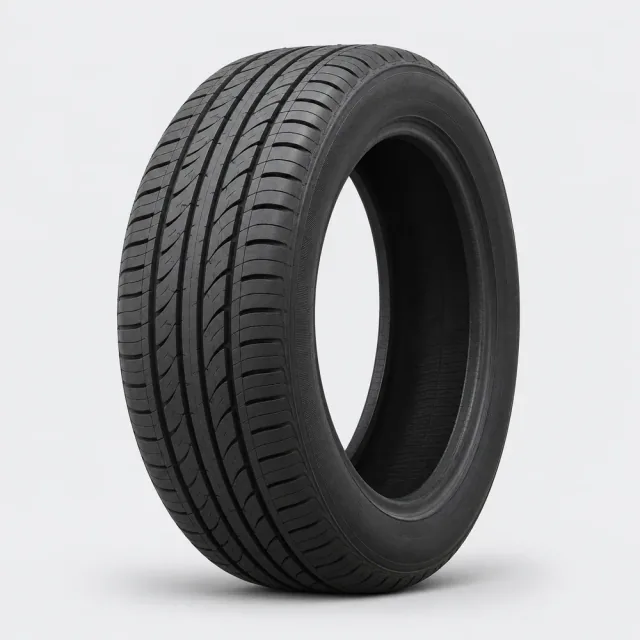
A car tyre is not a solid ring of rubber. It is a carefully built composite containing rubber compounds, reinforcing cords, steel and an air-retaining inner layer. The tread meets the road, while the carcass and beads control the shape and transfer loads to the wheel. This representative radial passenger tyre omits many recipe details. Its materials explain the construction, not how to alter, repair or decide the safety of a particular tyre.
Start with a part, then follow a material. No specialist knowledge needed.
Inside the object
Original conceptual illustration. Numbers open the component index; their positions are illustrative, not a disassembly guide. Equivalent text follows beside the diagram.
1Tread compound
The tread combines rubber polymers with fillers and other ingredients to balance grip, wear and deformation. Natural rubber can be blended with synthetic rubber; silica is one reinforcing filler. The rubber formulation and tread pattern work together, so no single ingredient determines braking or wet-weather behaviour.
2Steel belts
Steel cords beneath the tread reinforce the tyre and help control its shape under load. These are many fine reinforcing elements, not a solid steel ring. Their arrangement and bond to surrounding rubber are essential, and corrosion or separation can undermine the composite even when the tread surface looks intact.
3Carcass cords
Textile cords support the tyre’s shape while allowing repeated flexing. Polyester and nylon are among the reinforcement materials used in different locations and constructions. The rubber protects and transfers loads between cords. A fibre alone cannot perform the task without suitable orientation and bonding in the tyre.
4Bead
High-strength steel wires form the bead region that anchors the tyre at the wheel rim. Rubber compounds and reinforcing layers surround it. This interface must withstand service loads while retaining the tyre correctly, so tyre size and rim compatibility are properties of a designed assembly, not merely matching materials.
5Inner liner and sidewall
A tubeless tyre uses a low-permeability inner liner, commonly a halobutyl rubber compound outside this atlas. The sidewall uses other rubber blends to tolerate flexing and exposure. Natural rubber may be an ingredient, but it should not be mistaken for the complete air-barrier formulation.
Why these materials?
The tyre’s flexibility is organized, not unrestricted. Reinforcing cords limit growth in chosen directions while rubber accommodates deformation and transfers force. Fillers change the rubber compound’s response, and chemical crosslinks created during vulcanization help it recover after distortion. That crosslinked structure also explains why a used tyre does not remelt like an ordinary thermoplastic bottle. Its useful life involves tread wear, ageing, damage and operating conditions together. Consequently, a visible material list or remaining tread alone cannot determine whether a specific tyre remains safe to use.
One object, many versions.
Radial passenger tyres, truck tyres, racing tyres and bicycle tyres use different reinforcement and rubber systems. Winter and summer compounds have different operating aims. Some commercial tyres can be retreaded through controlled inspection and processing, but that does not mean every used tyre is a candidate. Tyre selection, pressure and repairs must follow vehicle and tyre guidance.
What happens after use?
Use a tyre retailer or authorized collection route for discarded tyres. Recovery may include retreading where suitable, separation of steel, production of rubber crumb or other controlled treatment, depending on the region. These routes do not all return the material to new tyres. Never burn tyres or attempt to extract their materials at home; the bonded composite needs appropriate industrial handling.
Put the choices side by side.
Familiar things, connected.



Follow the evidence
Original explanations informed by the sources below. Technical and industry sources support material behaviour; industry environmental marketing is not treated as a universal comparison. Read our editorial method.
- Materials: Basic knowledge of tires ↗Bridgestone · Undated · Checked 2026-11-13
- Structure: Basic knowledge of tires ↗Bridgestone · Undated · Checked 2026-11-13
- Natural Rubber at a glance ↗Michelin · Undated · Checked 2026-11-13
- Introduction to rubber processing and safety issues ↗UK Health and Safety Executive · Undated · Checked 2026-11-13
- Silica ↗Sibelco · Undated · Checked 2026-11-13
- Silica is safe — frequently asked questions ↗Evonik · Undated · Checked 2026-11-13
- Silica dust ↗UK Health and Safety Executive · Undated · Checked 2026-11-13
- What is steel? ↗World Steel Association · Undated · Checked 2026-11-13
- Raw materials ↗World Steel Association · Undated · Checked 2026-11-13
- Polyesters (Thermoplastic) PETP, PBT, PET ↗British Plastics Federation · Undated · Checked 2026-11-13
- Melt Spinning ↗Textile Exchange · Undated · Checked 2026-11-13
- Microplastics from textiles: towards a circular economy for textiles in Europe ↗European Environment Agency · 2022 · Checked 2026-11-13
- Nylons (Polyamide) ↗British Plastics Federation · Undated · Checked 2026-11-13