House keys
A small metal profile carries a mechanical code.
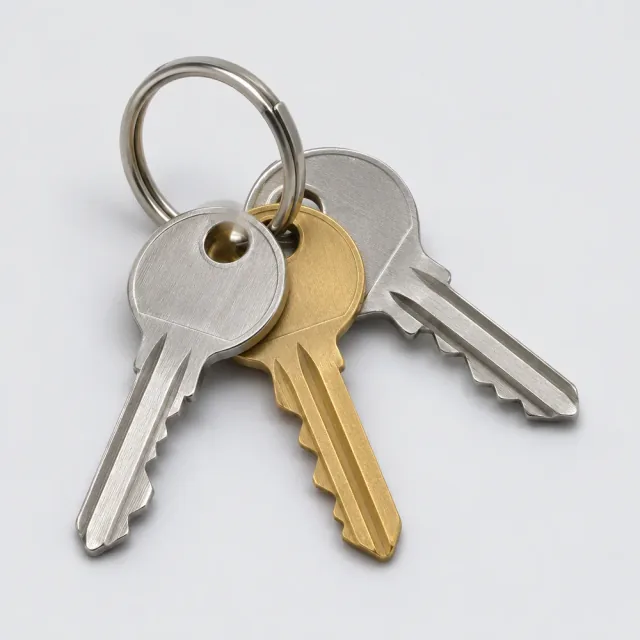
An ordinary house key is a shaped tool whose edges and grooves interact with a lock. Its metal must tolerate repeated insertion and modest twisting while being economical to form accurately. This representative set contains a nickel-plated brass key on a steel split ring. The blade and bow are regions of one key blank, not separately assembled pieces, and electronic access keys add a very different set of components.
Start with a part, then follow a material. No specialist knowledge needed.
Inside the object
Original conceptual illustration. Numbers open the component index; their positions are illustrative, not a disassembly guide. Equivalent text follows beside the diagram.
1Key blade
The blade can be formed from brass, a copper–zinc alloy that is practical to machine into a controlled profile. Grooves guide insertion and cut features interact with the intended lock mechanism. Its shape is functional, while excessive wear or bending can prevent reliable operation even if the metal remains intact.
2Bow or head
The enlarged bow gives fingers a place to grip and turn the same metal blank. Its width increases the available leverage without requiring a thick blade. A hole accepts the ring; sharp corners or a thin section around that hole can become local stress concentrations during rough handling.
3Surface finish
A thin nickel coating is used on some brass keys to change appearance and protect the surface. It is a plated layer, not proof that the key is solid nickel. Unplated brass and nickel-silver key blanks are alternatives; nickel silver is a copper–nickel–zinc alloy and contains no necessary silver.
4Split ring
A springy steel ring holds several keys together by keeping overlapping turns pressed against one another. Its function comes from wire shape and elastic response as well as composition. A surface finish may resist corrosion, while repeated over-opening can leave the ring distorted and less secure.
Why these materials?
A key illustrates the value of controlled dimensions. Harder is not automatically better: the key must be manufactured precisely, survive service, and interact appropriately with the lock’s internal materials. Brass offers a useful combination of machinability, corrosion behaviour and strength for many blanks. A thin coating can alter the surface without changing the bulk alloy. The ring follows a different logic, using spring response to keep an opening closed. Grouping both as “metal” hides the difference between a carefully profiled operating tool and a flexible retaining part attached to it.
One object, many versions.
Key blanks may use brass, nickel silver, steel or other alloys. Plastic-headed keys add a moulded grip, and vehicle keys may hide a transponder or battery-powered electronics. Dimple, tubular and flat keys have different geometries. The silver colour of a key cannot distinguish nickel plating, stainless steel and nickel silver by itself.
What happens after use?
A working spare may remain useful for as long as the corresponding lock remains in service. Keep access and privacy in mind when transferring a property or discarding identifiable key sets. Metal collection services may accept obsolete keys and rings, but local rules differ for small items. Electronic key fobs and their batteries need the appropriate electronics or battery collection route rather than ordinary scrap assumptions.
Familiar things, connected.
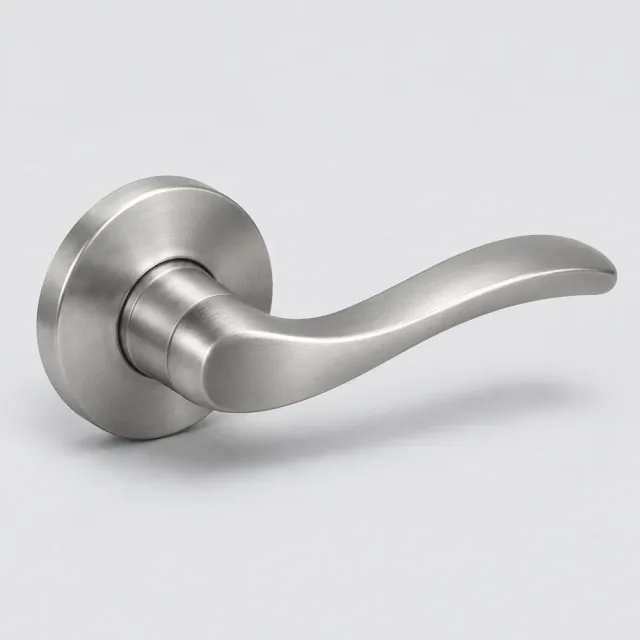
Door handle
A hand-sized lever translates a small movement into a latch action.
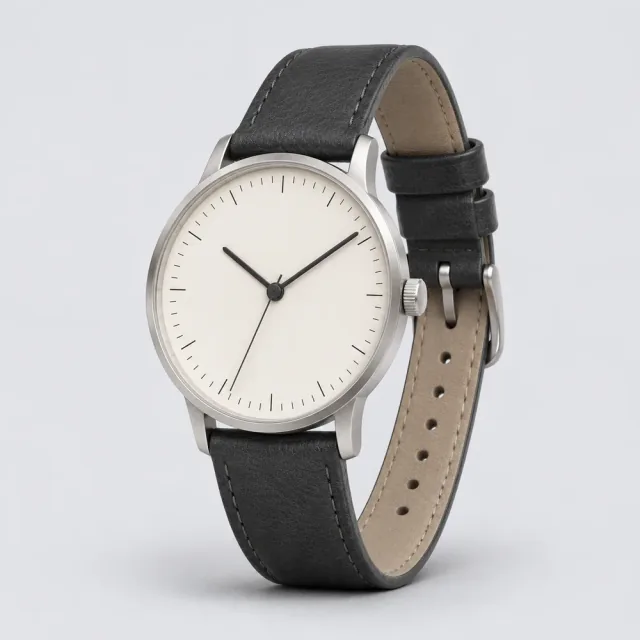
Quartz wristwatch
A tiny vibrating crystal provides the rhythm for moving hands.

Bicycle
Strength depends on shape as well as substance.
Follow the evidence
Original explanations informed by the sources below. Technical and industry sources support material behaviour; industry environmental marketing is not treated as a universal comparison. Read our editorial method.
- Residential and Commercial Key Blanks ↗Ilco · Undated · Checked 2026-11-13
- C73500 Nickel Silver: Copper Alloy Database ↗Copper Development Association · Undated · Checked 2026-11-13
- Introduction to copper and copper alloys ↗Copper Information Center / International Copper Association · 2021-04-21 · Checked 2026-11-13
- Brasses ↗Copper Information Center / International Copper Association · 2021-04-29 · Checked 2026-11-13
- Preventing and Treating the Dezincification of Brass — CCI Notes 9/13 ↗Canadian Conservation Institute · Undated · Checked 2026-11-13
- Nickel — element information, properties and uses ↗Royal Society of Chemistry · Undated · Checked 2026-11-13
- Mineral Commodity Summaries 2026 — Nickel ↗U.S. Geological Survey, National Minerals Information Center · 2026-05-27 (version 1.3) · Checked 2026-11-13
- How Do I Recycle Common Recyclables ↗U.S. Environmental Protection Agency · Undated · Checked 2026-11-13
- What is steel? ↗World Steel Association · Undated · Checked 2026-11-13
- Raw materials ↗World Steel Association · Undated · Checked 2026-11-13