Door handle
A hand-sized lever translates a small movement into a latch action.
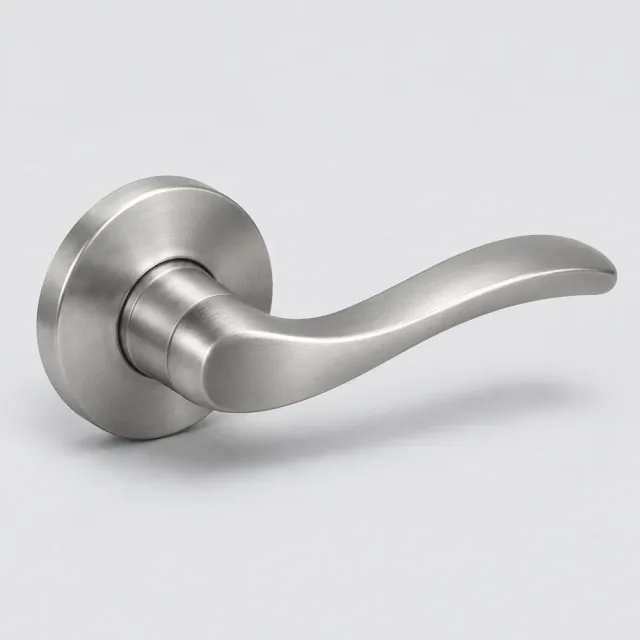
A lever door handle is a compact mechanical assembly disguised as a single visible fitting. The lever provides grip and leverage, a spindle transmits rotation, and springs and bearings control the return and feel. This representative interior handle uses a brass lever with steel working parts. The latch, door and lock remain separate systems, and specialist doors require compatible hardware tested for their intended application.
Start with a part, then follow a material. No specialist knowledge needed.
Inside the object
Original conceptual illustration. Numbers open the component index; their positions are illustrative, not a disassembly guide. Equivalent text follows beside the diagram.
1Lever
Brass can be cast, forged or machined into a shaped lever with useful stiffness and corrosion behaviour. Its mass and surface finish influence how the handle feels in the hand. A brass-coloured coating can also cover a different base metal, so appearance alone cannot confirm solid-brass construction.
2Spindle
A steel spindle passes through the door assembly and transmits turning motion to the latch mechanism. Its cross-section and fit help prevent unwanted slip. The spindle performs a mechanical transmission job, unlike the decorative cover, and must match the complete handle and latch arrangement.
3Return spring
A spring-steel element in the handle assembly can help the lever return after release. Elastic deformation stores energy while the handle is pressed. Some products rely differently on the latch spring, so a handle’s return behaviour depends on the matched assembly rather than the visible lever material alone.
4Bearing or bushing
A low-friction polymer bushing, including POM in some designs, can guide the rotating hub and reduce rubbing between metal surfaces. Other bearing materials are used too. Clearance, wear and support geometry influence whether the handle feels smooth or loose; polymer identity is only one part of that result.
5Rose and fixings
The rose covers the mounting region and can support the handle’s bearing assembly, while steel fasteners hold the fitting to the door. Decorative covers may conceal more substantial mounting plates. Their connections must transmit repeated hand loads without crushing the door material or gradually loosening.
Why these materials?
The handle multiplies a modest hand force through its lever arm, then passes that action through several small interfaces. The visible brass part needs shape, stiffness and a suitable surface; the spindle needs a reliable torque path; the spring needs elastic recovery; and the bearing needs controlled friction. Asking one material to perform all four jobs would impose unnecessary compromises. Surface treatments can provide a selected appearance without changing the internal mechanism. Easy access to replaceable fixings or springs can also make a meaningful difference to the service life of an otherwise durable metal fitting.
One object, many versions.
Handles may be made from stainless steel, aluminium, zinc alloys, wood or other materials. Knobs use different hand geometry, while electronic locks add circuits and power sources. Surface finishes and copper content do not justify a general claim that a handle prevents infection. Fire, accessibility and security performance belong to specified complete hardware and door systems.
What happens after use?
A loose fitting may be repairable, but replacements need to remain compatible with the door and latch. Fire-rated or security-critical doors should be maintained through appropriate qualified service. Sound hardware can sometimes be reused; separate metal assemblies may be accepted by scrap services. Plating, polymer bushings and mixed fasteners mean the whole item is not a single pure metal, so collection requirements should be checked locally.
Familiar things, connected.

Follow the evidence
Original explanations informed by the sources below. Technical and industry sources support material behaviour; industry environmental marketing is not treated as a universal comparison. Read our editorial method.
- ABLOY Door Handles ↗ABLOY · Undated · Checked 2026-11-13
- ASSA ABLOY Classic Mini Catalogue ↗ASSA ABLOY · 2022 · Checked 2026-11-13
- Door and Window Handles: Environmental Product Declaration ↗ARGE — European Federation of Locks and Building Hardware Manufacturers, hosted by ABLOY · Undated · Checked 2026-11-13
- Introduction to copper and copper alloys ↗Copper Information Center / International Copper Association · 2021-04-21 · Checked 2026-11-13
- Brasses ↗Copper Information Center / International Copper Association · 2021-04-29 · Checked 2026-11-13
- Preventing and Treating the Dezincification of Brass — CCI Notes 9/13 ↗Canadian Conservation Institute · Undated · Checked 2026-11-13
- What is steel? ↗World Steel Association · Undated · Checked 2026-11-13
- Raw materials ↗World Steel Association · Undated · Checked 2026-11-13
- Polyacetals POM ↗British Plastics Federation · Undated · Checked 2026-11-13
- Ultraform (POM) — Polyoxymethylene solutions ↗BASF · Undated · Checked 2026-11-13