Quartz wristwatch
A tiny vibrating crystal provides the rhythm for moving hands.
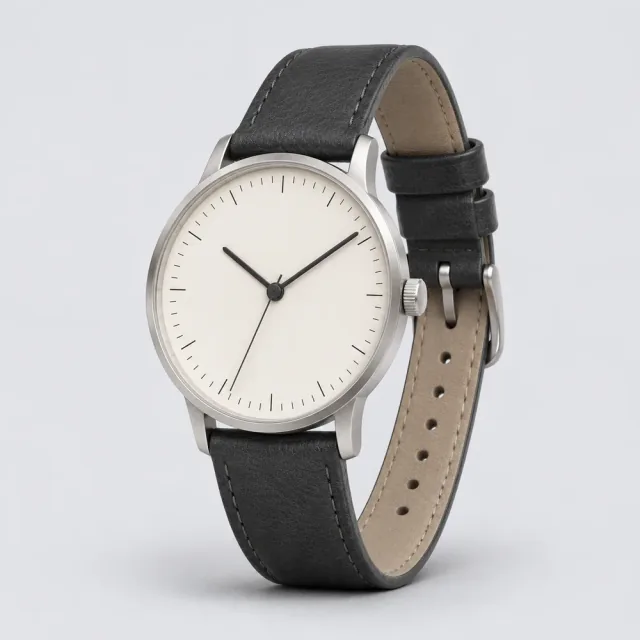
A quartz wristwatch turns a stable electrical timing signal into a readable display. A crystal resonator and electronic circuit regulate a small motor, while the case, window and strap protect the mechanism and keep it wearable. This representative analogue watch uses a steel case, synthetic sapphire window and a silver-oxide button cell. These are common options, not the exact specification of every quartz watch or a guide to opening one.
Start with a part, then follow a material. No specialist knowledge needed.
Inside the object
Original conceptual illustration. Numbers open the component index; their positions are illustrative, not a disassembly guide. Equivalent text follows beside the diagram.
1Case
Stainless steel forms a durable case that protects the movement and supports the crown and window. Its corrosion resistance is useful against ordinary wear, but grade, finish and contact conditions still matter. Water resistance depends on the complete case, seals and assembly, not simply on the presence of stainless steel.
2Transparent window
Synthetic sapphire is crystalline aluminium oxide, or alumina, used for a hard transparent watch window. It is not ordinary glass despite the familiar term “watch crystal.” High scratch resistance does not mean the window cannot chip or fracture, especially when an impact concentrates force at an edge.
3Timing electronics
A carefully shaped quartz crystal, a crystalline form of silica, resonates in an electronic oscillator. A silicon integrated circuit processes the signal to control the display mechanism. Quartz and silicon are chemically distinct: the resonator is silicon dioxide, while the semiconductor chip is based on elemental silicon.
4Motor and gear train
A small coil with copper winding helps drive a stepping motor, whose rotation is reduced and distributed through gears to move the hands. Metals and engineering polymers both occur in watch mechanisms. The gears need low friction and controlled dimensions; their tiny size makes assembly and cleanliness especially important.
5Button cell
A silver-oxide primary cell is one common power source for an analogue quartz watch. Silver is present in an oxide active material and zinc participates in the electrochemistry; this is not a solid silver battery. Other watch designs use different cell chemistries, including rechargeable cells in solar-powered models.
6Strap
A leather strap provides a flexible band that conforms around the wrist, with stitching, lining and a buckle completing the assembly. Leather type, tanning and finish affect response to moisture and wear. A replacement strap can extend the watch’s usable life without changing its timing mechanism.
Why these materials?
The watch places distinct jobs within a very small space. The window needs transparency and surface durability, the case needs strength, and the strap needs flexibility. Inside, a crystal and circuit regulate time while a motor supplies carefully metered motion. The word crystal can obscure an important difference: the quartz resonator establishes the rhythm, whereas a sapphire window merely protects the display. The battery’s stored chemical energy powers both the circuit and movement. Making these parts compact helps wearability, but also means repairs and resealing can require specialized tools and knowledge rather than casual disassembly.
One object, many versions.
Mechanical watches use a spring-driven escapement rather than quartz timing. Digital quartz watches replace the hands with an electronic display. Windows may be acrylic or mineral glass instead of sapphire, and straps may be silicone, textile or a metal bracelet. Solar quartz watches contain a rechargeable cell and should not be treated as though they take an ordinary primary silver-oxide replacement.
What happens after use?
A watch repairer can replace worn straps, service the mechanism and replace the correct cell while checking seals where needed. Button cells must be kept away from children and collected through an appropriate battery route. Do not place a battery-containing watch in ordinary packaging recycling. Reuse, repair and specialist electronics collection are preferable routes to investigate, depending on condition and local services.
Familiar things, connected.
Follow the evidence
Original explanations informed by the sources below. Technical and industry sources support material behaviour; industry environmental marketing is not treated as a universal comparison. Read our editorial method.
- SUR555 Essentials: materials and movement ↗Seiko · Undated · Checked 2026-11-13
- Quartz: Watch Knowledge ↗Seiko Watch Corporation · Undated · Checked 2026-11-13
- SEIZAIKEN Mercury-Free Silver Oxide Battery ↗Seiko Instruments · Undated · Checked 2026-11-13
- Sapphire Windows: optical material information ↗Edmund Optics · Undated · Checked 2026-11-13
- General principles for selection of stainless steels ↗British Stainless Steel Association · Undated · Checked 2026-11-13
- Recycling ↗worldstainless · Undated · Checked 2026-11-13
- Advanced Ceramic Substrates for Electronic Applications ↗CeramTec · Undated · Checked 2026-11-13
- Aluminum Production and Processing ↗The Aluminum Association · Undated · Checked 2026-11-13
- Silica ↗Sibelco · Undated · Checked 2026-11-13
- Silica is safe — frequently asked questions ↗Evonik · Undated · Checked 2026-11-13
- Silica dust ↗UK Health and Safety Executive · Undated · Checked 2026-11-13
- Silicon — element information, properties and uses ↗Royal Society of Chemistry · Undated · Checked 2026-11-13
- Mineral Commodity Summaries 2026 — Silicon ↗U.S. Geological Survey, National Minerals Information Center · 2026-05-27 (version 1.3) · Checked 2026-11-13
- Solar Photovoltaic Manufacturing Basics ↗U.S. Department of Energy · Undated · Checked 2026-11-13
- How Do I Recycle Common Recyclables ↗U.S. Environmental Protection Agency · Undated · Checked 2026-11-13
- Mineral Commodity Summaries 2026 — Copper ↗U.S. Geological Survey, National Minerals Information Center · 2026-05-27 (version 1.3) · Checked 2026-11-13
- Copper Life Cycle ↗International Copper Association · Undated · Checked 2026-11-13
- What is steel? ↗World Steel Association · Undated · Checked 2026-11-13
- Raw materials ↗World Steel Association · Undated · Checked 2026-11-13
- Silver — Element information, properties and uses ↗Royal Society of Chemistry · Undated · Checked 2026-11-13
- Silver Statistics and Information ↗U.S. Geological Survey, National Minerals Information Center · Undated · Checked 2026-11-13
- Solar Photovoltaic Manufacturing Basics ↗U.S. Department of Energy · Undated · Checked 2026-11-13
- Zinc — element information, properties and uses ↗Royal Society of Chemistry · Undated · Checked 2026-11-13
- Mineral Commodity Summaries 2026 — Zinc ↗U.S. Geological Survey, National Minerals Information Center · 2026-05-27 (version 1.3) · Checked 2026-11-13
- Get to know how modern leather is made ↗Leather Working Group · 2025-07-08 · Checked 2026-11-13
- Modern Cow Leather Processing, version 1.1 ↗Leather Naturally; editor Luis Zugno · Undated · Checked 2026-11-13
- Back to Basics: Leather Manufacture ↗Leather Naturally / World Leather · Undated · Checked 2026-11-13