Frying pan
Heat spreading and food release ask for different surfaces.
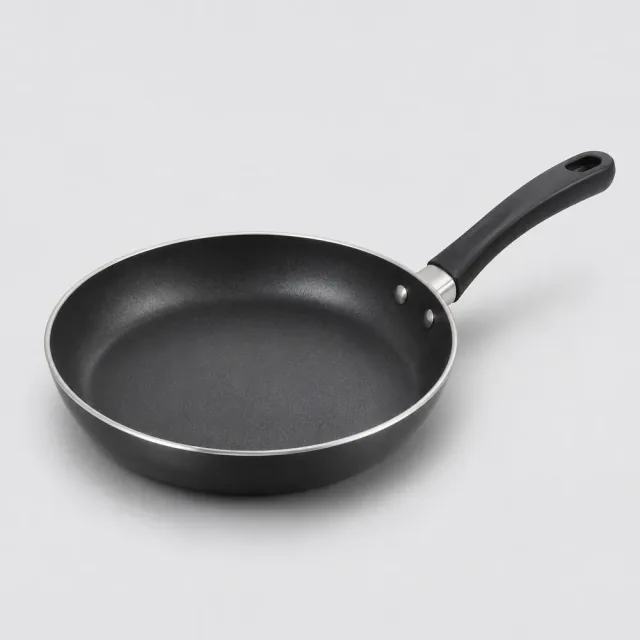
A frying pan must receive heat, spread it across a cooking surface and remain manageable by its handle. A nonstick aluminium pan separates these functions: aluminium spreads heat, a coating changes the food-contact surface, and a handle reduces heat transfer to the hand. This example shows that construction, with an optional magnetic base for induction. Cast iron, carbon steel, stainless and ceramic-coated pans follow different strategies.
Start with a part, then follow a material. No specialist knowledge needed.
Inside the object
Original conceptual illustration. Numbers open the component index; their positions are illustrative, not a disassembly guide. Equivalent text follows beside the diagram.
1Pan body
An aluminium body spreads heat relatively readily and can be formed or cast into a broad cooking vessel. Thickness and base shape affect temperature distribution and resistance to distortion. The metal underneath the coating is therefore an active part of cooking performance, not simply a support for the finish.
2Nonstick surface
Some nonstick pans use a PTFE-containing coating system. Its low surface adhesion helps food release, but the coating has its own wear and temperature limits. Multiple layers and reinforcement may be present. Ceramic-coated pans use different chemistry, so a smooth nonstick appearance does not identify PTFE.
3Induction-compatible base
A magnetic steel layer or insert can allow an aluminium pan to couple to a common induction hob. Not every stainless grade is magnetic, and a plain aluminium body does not provide the same response. The bonded base must work thermally and mechanically with the rest of the pan.
4Handle and fasteners
A handle may use metal, a heat-resistant polymer or a metal structure with silicone grip regions. Rivets, screws or welded joints transfer the load of the filled pan. Handle material and attachment determine permitted use; oven suitability cannot be inferred from the pan body alone.
Why these materials?
No single property defines a good pan for every purpose. Aluminium spreads heat, but a cooking surface may need different chemical and release behaviour. Adding a coating changes surface performance without replacing the bulk metal. Adding magnetic steel changes compatibility with induction heating. The result is a layered engineering system whose performance also depends on thickness, flatness and handling. A heavy cast-iron pan follows another approach, storing substantial heat because of its mass. These are trade-offs between response, surface care, weight and use rather than a universal ranking of materials.
One object, many versions.
Bare cast iron and carbon steel commonly rely on a maintained seasoned surface. Stainless cookware may use an aluminium or copper core, while ceramic-coated aluminium uses a different nonstick formulation. Labels such as granite or titanium may refer to finishes or ingredients rather than the bulk pan. Read the specific construction and use instructions to understand what the name actually describes.
What happens after use?
Care for the cooking surface according to the manufacturer, including its heating and utensil limits. A worn coating cannot be restored safely by arbitrary household resurfacing. Usable cookware can be passed on when its condition and use limits are clear. Damaged pans may be accepted at metal recovery facilities, but handles and coatings affect processing; ordinary packaging collection is not automatically the correct route.
Put the choices side by side.
Familiar things, connected.
Follow the evidence
Original explanations informed by the sources below. Technical and industry sources support material behaviour; industry environmental marketing is not treated as a universal comparison. Read our editorial method.
- The secret of pan manufacture ↗Tefal / Groupe SEB · Undated · Checked 2026-11-13
- Pots and pans: cookware materials ↗Tefal / Groupe SEB · Undated · Checked 2026-11-13
- Aluminum Production and Processing ↗The Aluminum Association · Undated · Checked 2026-11-13
- Mineral Commodity Summaries 2026 — Aluminum ↗U.S. Geological Survey, National Minerals Information Center · 2026-05-27 (version 1.3) · Checked 2026-11-13
- Fluoroplastics PTFE FEP ↗British Plastics Federation · Undated · Checked 2026-11-13
- No adverse health effects to be expected from cookware with PTFE non-stick coating ↗German Federal Institute for Risk Assessment (BfR) · 2025 · Checked 2026-11-13
- General principles for selection of stainless steels ↗British Stainless Steel Association · Undated · Checked 2026-11-13
- Recycling ↗worldstainless · Undated · Checked 2026-11-13
- Room Temperature Vulcanizing (RTV) Silicones: Material and Processing Guidelines ↗WACKER Chemie · Undated · Checked 2026-11-13
- Products & Services — Annual Report 2025 ↗WACKER Chemie · 2026 (report for 2025) · Checked 2026-11-13