What makes a good pan?
A pan is a system: the cooking surface, heat-spreading core, handle and stove all matter. Comparing only the material named on the box misses much of the design. These are qualitative tendencies, not a product ranking.
On a phone, each design question stacks the material choices for easier reading.
| Design question | Cast iron | Aluminium | Stainless steel |
|---|---|---|---|
| Heat spreading | Slower heat spreading; a thick base reduces local variations. | Spreads heat readily, making it useful as a core. | Less conductive than aluminium; often paired with a conductive core. |
| Weight and response | Commonly thick and heavy; stores considerable heat. | Low density supports lighter cookware; response also depends on thickness and construction. | Weight and response depend strongly on wall and core thickness. |
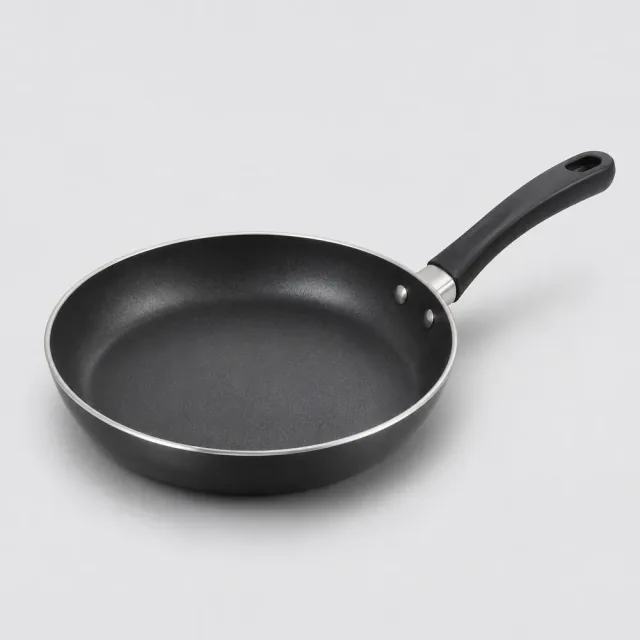
| Cooking surface | Seasoned or enamelled surfaces need different care. | Often coated, anodised or covered by another metal. | Durable food-contact surface; sticking depends on cooking technique. |
| Design constraint | Brittleness and weight constrain thin shapes. | An aluminium base alone is not magnetic for induction. | Induction suitability depends on the grade and base construction. |
What changes the answer?
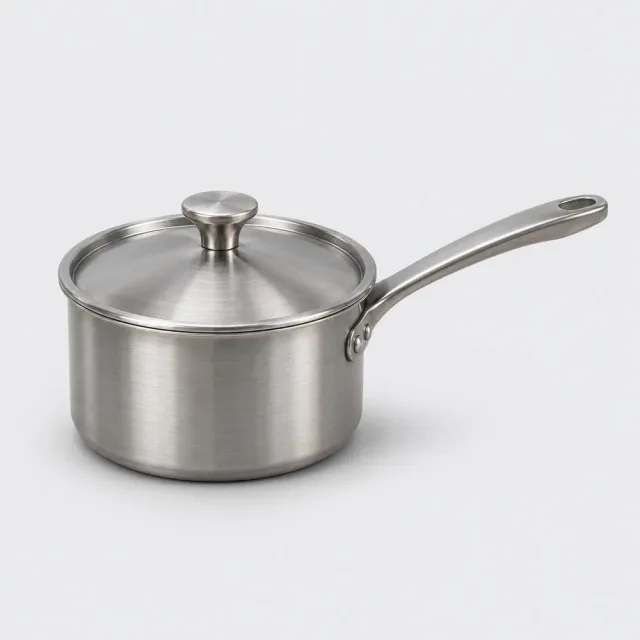
Read the whole construction. A stainless pan with an aluminium core deliberately combines different strengths; it is not a compromise that can be judged by a single material label.
Keep following the thread
All objects ↗Familiar things, connected.
Follow the evidence
Original explanations informed by the sources below. Technical and industry sources support material behaviour; industry environmental marketing is not treated as a universal comparison. Read our editorial method.
- Sand casting ↗The Open University · 2017 · Checked 2026-11-13
- Raw materials ↗World Steel Association · Undated · Checked 2026-11-13
- Aluminum Production and Processing ↗The Aluminum Association · Undated · Checked 2026-11-13
- Mineral Commodity Summaries 2026 — Aluminum ↗U.S. Geological Survey, National Minerals Information Center · 2026-05-27 (version 1.3) · Checked 2026-11-13
- General principles for selection of stainless steels ↗British Stainless Steel Association · Undated · Checked 2026-11-13
- Recycling ↗worldstainless · Undated · Checked 2026-11-13
- The secret of pan manufacture ↗Tefal / Groupe SEB · Undated · Checked 2026-11-13
- Pots and pans: cookware materials ↗Tefal / Groupe SEB · Undated · Checked 2026-11-13
- MIDDAGSMAT saucepan: construction and materials ↗IKEA · Undated · Checked 2026-11-13