Ballpoint pen
A tiny rolling contact meters a line of ink.
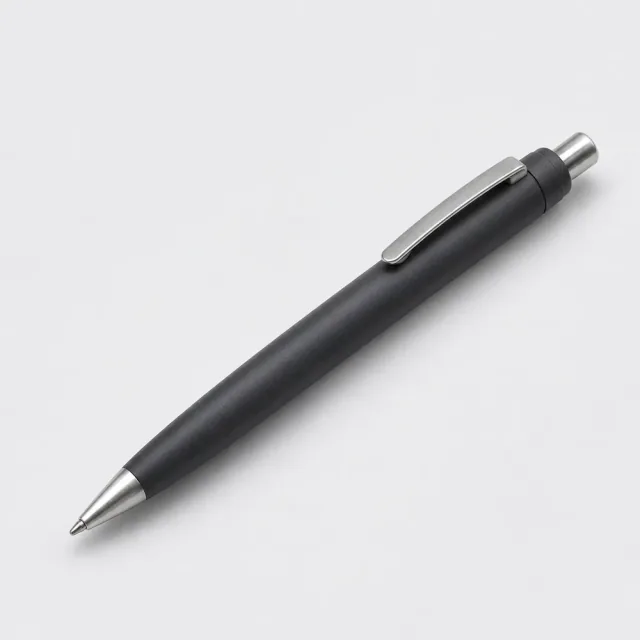
A ballpoint pen controls a liquid through a very small mechanical contact. A hard ball turns in a shaped socket, picking up ink from inside and leaving it on paper. The surrounding parts keep the ink contained and the point usable. This representative capped disposable pen combines a clear plastic barrel, a separate reservoir and a metal point, with refillable and retractable designs using other arrangements.
Start with a part, then follow a material. No specialist knowledge needed.
Inside the object
Original conceptual illustration. Numbers open the component index; their positions are illustrative, not a disassembly guide. Equivalent text follows beside the diagram.
1Barrel
Clear polystyrene can form a rigid barrel through which the ink supply remains visible. A faceted shape can improve grip and reduce rolling on a desk. Its transparency and mouldability are useful, while its susceptibility to cracking means wall thickness and shape still matter during handling.
2Ink reservoir
A slim polymer tube, made from polypropylene in some constructions, holds the ink behind the writing point. It needs chemical compatibility with the specific ink and a reliable connection to the tip. The refill is a separate functional system even when the pen is sold as non-refillable.
3Point and socket
Machined metal, including brass in some ballpoint tips, supports the rolling ball and maintains its small working clearance. Stainless steel and other tip constructions also exist. A tiny variation at the socket can change ink delivery, showing why manufacturing precision matters even in a low-cost everyday object.
4Writing ball
Tungsten carbide is used for the writing ball in familiar ballpoint designs because the contact needs to resist wear while rolling over paper. It is a hard ceramic compound outside this atlas’s current material index. It should not be confused with graphite simply because both involve carbon.
Composition explained here; no separate material entry in this edition.
5Cap and end plug
Moulded polypropylene can provide a cap that tolerates repeated flexing as it is fitted and removed. The cap protects the point during storage, while a plug closes the other end of the body. Small-part and ventilation features are product safety matters; the cap is not intended to be placed in the mouth.
6Ink
Ballpoint ink is a formulated mixture of colorants and a liquid vehicle, with additives controlling flow, drying and interaction with paper. Its exact chemistry varies. The coloured line is not made from the barrel polymer, and this atlas does not assign a single material identity to the complete ink mixture.
Composition explained here; no separate material entry in this edition.
Why these materials?
The pen’s central compromise is between flowing and staying put. Ink must reach the paper when the ball rolls, yet avoid leaking freely during storage. The ball, socket clearance and ink rheology work together to achieve that behaviour. A strong barrel alone cannot rescue a poorly performing point. Clear plastic makes the remaining ink visible at low mass and supports large-scale moulding, while a precise hard tip concentrates more demanding manufacture into a tiny part. Refillable designs separate the long-lived grip from the consumable ink system, but only retain that benefit when suitable refills remain available and are used.
One object, many versions.
Retractable pens add a spring and latch mechanism, while refillable metal pens may use brass, aluminium or stainless-steel bodies. Gel pens and rollerballs have different ink systems and are not simply identical ballpoints in a new casing. A pen’s outside shape or brand cannot reliably identify every polymer or the composition of its point.
What happens after use?
Using the remaining ink and refilling a compatible pen can avoid discarding usable parts. Keep small caps and refills away from children according to the product’s guidance. Pens mix tiny plastic and metal components with residual ink, so most are unsuitable for ordinary packaging sorting. Dedicated stationery collection schemes exist in some places, but acceptance and actual recovery routes should be checked locally.
Familiar things, connected.

Follow the evidence
Original explanations informed by the sources below. Technical and industry sources support material behaviour; industry environmental marketing is not treated as a universal comparison. Read our editorial method.
- Bic Cristal Ballpoint pen, 1950 ↗Museum of Modern Art · Undated · Checked 2026-11-13
- BIC Cristal: 75th anniversary press kit ↗BIC · 2025 · Checked 2026-11-13
- Writing Tips Catalogue ↗Premec · 2024 · Checked 2026-11-13
- Polystyrene ↗INEOS · Undated · Checked 2026-11-13
- Expanded and Extruded Polystyrene (EPS/XPS) ↗British Plastics Federation · Undated · Checked 2026-11-13
- Plastics Processes ↗British Plastics Federation · Undated · Checked 2026-11-13
- Polypropylene (PP) ↗British Plastics Federation · Undated · Checked 2026-11-13
- Plastics Processes ↗British Plastics Federation · Undated · Checked 2026-11-13
- Introduction to copper and copper alloys ↗Copper Information Center / International Copper Association · 2021-04-21 · Checked 2026-11-13
- Brasses ↗Copper Information Center / International Copper Association · 2021-04-29 · Checked 2026-11-13
- Preventing and Treating the Dezincification of Brass — CCI Notes 9/13 ↗Canadian Conservation Institute · Undated · Checked 2026-11-13