Bound book
Paper becomes a durable sequence through its binding.
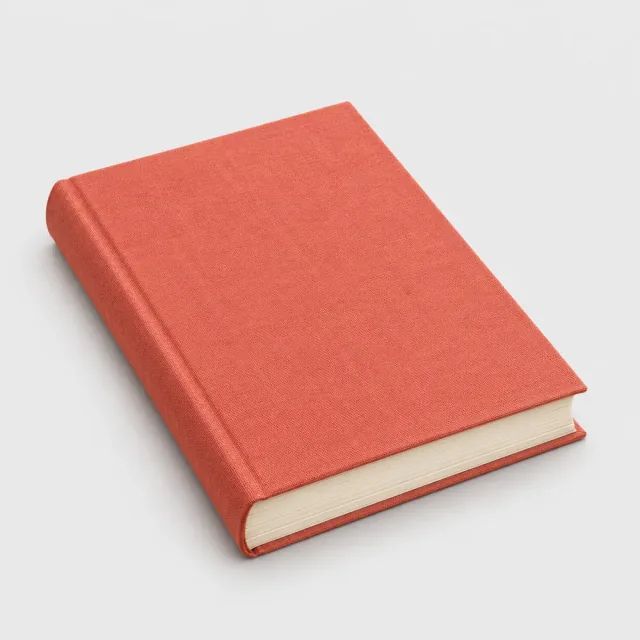
A bound book holds hundreds of flexible surfaces in a fixed order while allowing each to turn. The pages are only one part of that task. A cover protects their edges, a spine gathers sections, and threads or adhesives manage repeated opening. This representative cloth-covered hardback shows why a familiar paper object is actually a composite of paper, board, fabric, printing materials and a carefully designed joint.
Start with a part, then follow a material. No specialist knowledge needed.
Inside the object
Original conceptual illustration. Numbers open the component index; their positions are illustrative, not a disassembly guide. Equivalent text follows beside the diagram.
1Pages
Paper provides a thin, light surface for printed marks and repeated handling. Its fibres, fillers, sizing and optional coatings affect opacity, smoothness and ink behaviour. A bright white page is not simply pure cellulose, and a glossy page is not evidence that the whole sheet is plastic.
2Cover boards
Dense paperboard stiffens the covers and shields the page block from bending and edge damage. It may be made from multiple plies or consolidated fibres. The boards stop short of the spine hinge so that a rigid protective cover can still open around a flexible book block.
3Cover cloth
A woven cotton bookcloth can wrap the boards and bridge their edges. Commercial bookcloth often has a coating or backing to control glue penetration and improve handling. Leather, paper and synthetic fabrics are alternatives, so a textile-looking cover does not by itself identify the fibre.
4Sewing and hinges
Folded page sections can be sewn with cotton or polyester thread, with paper endpapers helping join the block to the cover assembly. Thread holds sections together while allowing motion at the fold. Not every modern hardback is sewn; some rely primarily on an adhesive binding.
5Binding adhesive
Some production bindings use an EVA hot-melt adhesive, which softens during manufacture and holds the spine after cooling. Other books use polyurethane, starch pastes or different adhesive systems. Adhesive choice must suit the paper and opening behaviour; the glue line is a designed joint rather than incidental residue.
6Printed marks
Printing inks contain colorants and vehicles whose formulations depend on the printing process and paper. They are not represented by a single material entry here. Their adhesion, light stability and interaction with the sheet influence whether small text and illustrations remain legible during storage and use.
Composition explained here; no separate material entry in this edition.
Why these materials?
A book must be stiff in some directions and flexible in others. Rigid covers protect the contents, but the spine and hinges must accommodate repeated opening. Paper grain direction, page size and the thickness of the book block influence how easily the pages lie open. Sewing can preserve a sequence of sections after a local adhesive failure, while adhesive-only production can simplify assembly and reduce cost. None of these choices guarantees longevity by itself. Moisture, light, handling and the compatibility of paper, ink and binding all contribute to the life of the finished object.
One object, many versions.
Paperbacks replace rigid boards with flexible card covers. Children’s board books use thicker leaves; art books may use heavily coated paper. Library bindings, notebooks and artist’s books can employ very different sewing structures. A digital edition removes the paper binding from that reading experience but introduces an electronic device with its own materials and energy use.
What happens after use?
Reading, lending, repair and resale can retain a book’s value as an ordered text. Store it in a reasonably stable, dry environment and support fragile bindings when handled. Valuable or damaged historical books may need a conservator rather than household tape. Paper collection rules vary for hard covers, adhesives and coated pages, so check local instructions before treating a whole book like loose office paper.
Familiar things, connected.
Follow the evidence
Original explanations informed by the sources below. Technical and industry sources support material behaviour; industry environmental marketing is not treated as a universal comparison. Read our editorial method.
- Basic Care of Books — CCI Notes 11/7 ↗Canadian Conservation Institute · Undated · Checked 2026-11-13
- Books and Bound Items ↗University of Illinois, Preservation Self-Assessment Program · Undated · Checked 2026-11-13
- How Quickly Can I Test Freshly Bound Books? ↗H.B. Fuller · 2018-04 · Checked 2026-11-13
- About Pulp & Paper ↗Confederation of European Paper Industries · Undated · Checked 2026-11-13
- How Is Paper Made Today? ↗American Forest & Paper Association · 2025-05-01 · Checked 2026-11-13
- Textile Fibers ↗Cotton Incorporated · 2013 · Checked 2026-11-13
- Fiber Preparation for Spinning ↗Cotton Incorporated / CottonWorks · Undated · Checked 2026-11-13
- Polyesters (Thermoplastic) PETP, PBT, PET ↗British Plastics Federation · Undated · Checked 2026-11-13
- Melt Spinning ↗Textile Exchange · Undated · Checked 2026-11-13
- Microplastics from textiles: towards a circular economy for textiles in Europe ↗European Environment Agency · 2022 · Checked 2026-11-13
- Ethylene Vinyl Acetate EVA ↗British Plastics Federation · Undated · Checked 2026-11-13
- Solar Photovoltaic Manufacturing Basics ↗U.S. Department of Energy · Undated · Checked 2026-11-13
- Solar Photovoltaics Supply Chain Deep Dive Assessment ↗U.S. Department of Energy · 2022-02-24 · Checked 2026-11-13