Polyacetal (POM)
Polyoxymethylene, commonly called POM, acetal or polyacetal, is an engineering thermoplastic used in precise moving parts. Its combination of stiffness, dimensional stability and favourable sliding behaviour can suit gears, clips, guides and fasteners. It is neither an adhesive nor the same polymer as acetate. Homopolymer and copolymer grades offer different balances of performance, and a branded acetal component still needs a grade specification to explain how it will behave.
Useful properties
Why it earns its placeUseful sliding behaviour ↗
POM can give low wear and friction in suitable contact pairs, but load, counterface, lubrication and temperature still govern performance.
Stiff small mechanisms ↗
Its stiffness and resistance to repeated loading help thin teeth, clips and mechanism parts retain their function.
Dimensional stability ↗
Low moisture uptake relative to many polyamides can help precision parts maintain dimensions, without making every grade chemically inert.
From input to useful material.
A simplified industrial pathway. Select a stage to learn what changes. Recycled feedstock and other process variants can enter at different stages.
Origins & processing
Industrial production builds chains containing repeating oxymethylene units from formaldehyde-derived feedstocks. Homopolymer and copolymer routes create related but distinct molecular structures, and stabilisation is essential to the usable resin. Pellets may include carefully selected modifiers for friction, colour or other requirements. Injection moulding makes many complex components; extrusion produces stock shapes for machining. Cooling and shrinkage influence accuracy, so tool design and processing conditions are part of the material’s practical performance rather than mere finishing details.
Where it turns up
POM appears in gears, bearings, zipper elements, snap fits and furniture components. It can be selected for some backpack fasteners or the small moving pieces in writing instruments and appliances. A plastic buckle cannot reliably be identified by appearance alone: nylon and other polymers also serve that role. Component drawings or supplier information are needed for a definite identification.
Useful, with limits.
Low surface adhesion can make reliable bonding or painting difficult. Excessive heat and incompatible contamination during processing can degrade the resin, so reprocessing requires controlled industrial practice. Strong acids and certain other environments are unsuitable. Creep, wear and fatigue still occur under demanding loads; a moulded gear’s service life depends on its geometry, partner gear and operating conditions as well as the polymer.
A next life depends on the system.
Clean manufacturing scrap can sometimes return to a controlled POM stream after assessment of grade and condition. Mixed small mechanisms are less straightforward because metal pins, springs and other plastics are difficult to separate economically. Repairing a product by replacing a worn gear may preserve far more material than discarding the assembly. POM should not be assumed compatible with ordinary mixed packaging recycling.
Familiar things, connected.

Backpack
A flexible container with a hidden load path.

Bicycle helmet
Protection comes from a carefully controlled collapse.
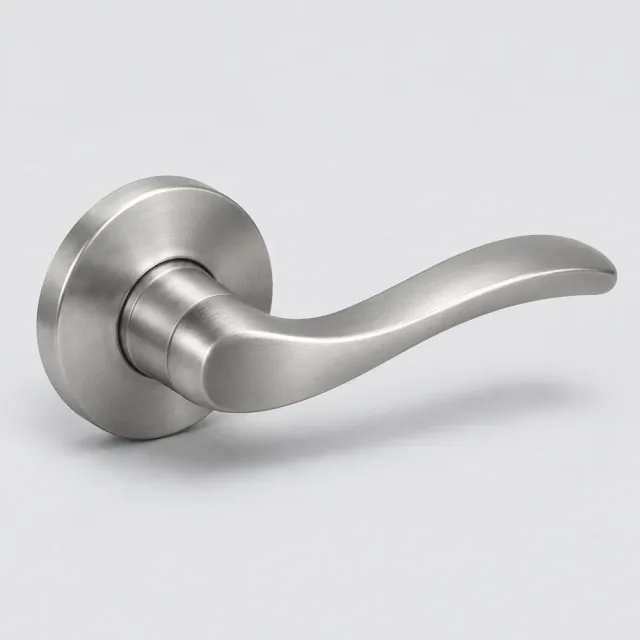
Door handle
A hand-sized lever translates a small movement into a latch action.
Kitchen knife
A hard cutting edge carried by a tougher, controllable whole.
Follow the evidence
Original explanations informed by the sources below. Technical and industry sources support material behaviour; industry environmental marketing is not treated as a universal comparison. Browse the source register.
- Polyacetals POM ↗British Plastics Federation · Undated · Checked 2026-11-13
- Ultraform (POM) — Polyoxymethylene solutions ↗BASF · Undated · Checked 2026-11-13