Solar panel
A fragile semiconductor protected for outdoor work.
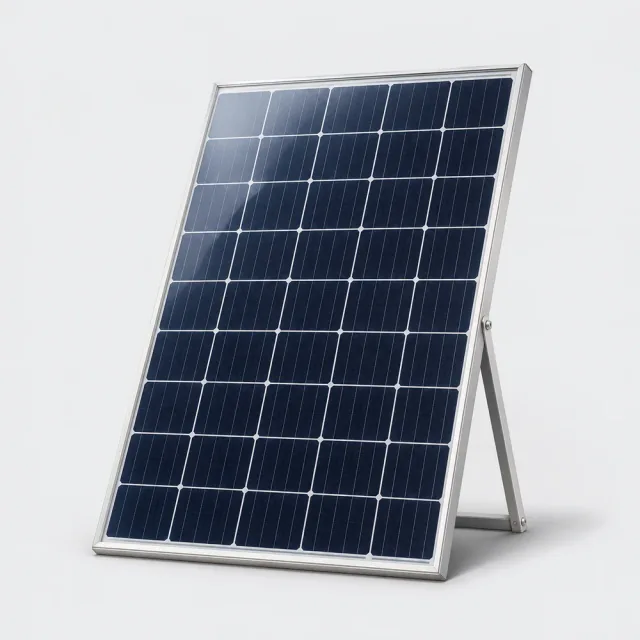
A crystalline-silicon solar panel is a layered electrical assembly designed to face sunlight, rain and changing temperatures. The silicon cells convert light into electricity, while glass, polymers and a frame protect and support them. This view describes a representative framed module, not a complete rooftop installation. Mounting equipment, inverters, wiring protection and storage batteries belong to the wider system and are not interchangeable with the panel itself.
Start with a part, then follow a material. No specialist knowledge needed.
Inside the object
Original conceptual illustration. Numbers open the component index; their positions are illustrative, not a disassembly guide. Equivalent text follows beside the diagram.
1Front cover
A low-iron glass cover transmits light while protecting the cells from weather and handling. It is commonly strengthened for its job. Transparency, surface treatments and mechanical strength all matter, but the cover does not itself generate the panel’s useful current; the semiconductor layers beneath it do.
2Solar cells
Purified crystalline silicon is made into thin wafers and processed into semiconductor junctions. The cell collects charges generated by absorbed light. Electrical contacts, coatings and doped regions are also present, so describing a cell as silicon identifies its main semiconductor rather than a chemically pure finished object.
3Encapsulant
EVA is one established polymer encapsulant used around cells to bond and protect the assembly. Optical clarity, electrical insulation and resistance to outdoor ageing matter. Other encapsulants are also used. The bonded layers help keep water and movement from damaging the very thin cells and their connections.
4Frame and connections
An aluminium frame supports the laminate and provides fixing interfaces. Copper-containing ribbons and cables carry current between cells and out of the module. Their conductor function is separate from the frame’s structural job; safe system wiring requires designed connectors, insulation and qualified installation.
5Rear protection
Some modules use a multilayer polymer backsheet with polyester among its layers; others use a second glass pane. Both constructions must support electrical insulation and weather protection. A backsheet may contain additional polymers outside this atlas, and glass-glass modules do not have the same layer stack.
Why these materials?
The semiconductor needs an environment that a bare wafer could not survive for long. Glass provides a durable front surface, while encapsulation holds fragile cells and connections in position. Thermal expansion differs between materials, so the assembly must tolerate movement without losing electrical or moisture protection. These bonds are useful during service but difficult to reverse during recycling. Recovering a frame or glass fraction is also different from recovering high-purity silicon and small quantities of contact metals. The panel’s layered construction explains why end-of-life treatment requires more than ordinary glass collection.
One object, many versions.
This is a crystalline-silicon module. Thin-film panels such as cadmium telluride use different semiconductor compounds and can have a different material balance. Glass-glass, frameless and bifacial designs also alter the construction. Panel labels, year of manufacture and technical documentation are necessary to identify a particular product; current global silicon production statistics cannot reveal its individual supply chain.
What happens after use?
A functioning panel may continue producing electricity even after an installation changes, but condition and electrical compatibility require professional assessment before reuse. Panels remain electrical equipment and should be handled through qualified solar or electronics recovery services. Local collection and processing capacity vary. Do not break a panel to separate its layers: glass, electrical hazards and material composition require controlled handling.
Put the choices side by side.
Familiar things, connected.


Follow the evidence
Original explanations informed by the sources below. Technical and industry sources support material behaviour; industry environmental marketing is not treated as a universal comparison. Read our editorial method.
- Crystalline Silicon Photovoltaics Research ↗U.S. Department of Energy · Undated · Checked 2026-11-13
- Photovoltaics End-of-Life Action Plan Update ↗U.S. Department of Energy · 2024-10 · Checked 2026-11-13
- How we make glass: chemistry of glass ↗Pilkington / NSG Group · Undated · Checked 2026-11-13
- About glass ↗British Glass · Undated · Checked 2026-11-13
- Quality of recycling: Towards a reference framework for the circular economy ↗European Commission Joint Research Centre · 2020 · Checked 2026-11-13
- Silicon — element information, properties and uses ↗Royal Society of Chemistry · Undated · Checked 2026-11-13
- Mineral Commodity Summaries 2026 — Silicon ↗U.S. Geological Survey, National Minerals Information Center · 2026-05-27 (version 1.3) · Checked 2026-11-13
- Solar Photovoltaic Manufacturing Basics ↗U.S. Department of Energy · Undated · Checked 2026-11-13
- How Do I Recycle Common Recyclables ↗U.S. Environmental Protection Agency · Undated · Checked 2026-11-13
- Ethylene Vinyl Acetate EVA ↗British Plastics Federation · Undated · Checked 2026-11-13
- Solar Photovoltaics Supply Chain Deep Dive Assessment ↗U.S. Department of Energy · 2022-02-24 · Checked 2026-11-13
- Aluminum Production and Processing ↗The Aluminum Association · Undated · Checked 2026-11-13
- Mineral Commodity Summaries 2026 — Aluminum ↗U.S. Geological Survey, National Minerals Information Center · 2026-05-27 (version 1.3) · Checked 2026-11-13
- Mineral Commodity Summaries 2026 — Copper ↗U.S. Geological Survey, National Minerals Information Center · 2026-05-27 (version 1.3) · Checked 2026-11-13
- Copper Life Cycle ↗International Copper Association · Undated · Checked 2026-11-13
- Polyesters (Thermoplastic) PETP, PBT, PET ↗British Plastics Federation · Undated · Checked 2026-11-13
- Melt Spinning ↗Textile Exchange · Undated · Checked 2026-11-13
- Microplastics from textiles: towards a circular economy for textiles in Europe ↗European Environment Agency · 2022 · Checked 2026-11-13