Skateboard
A springy deck above four engineered contact patches.
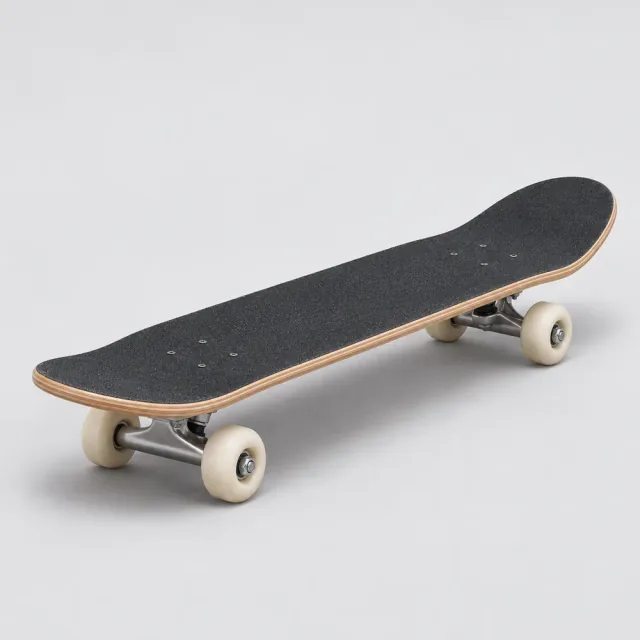
A skateboard combines a shaped plywood deck, steering trucks, rolling bearings and resilient wheels. The deck is more than a flat plank: its curved profile and laminated construction influence stiffness and the feel of loading and unloading it. This representative street board uses maple veneers and polyurethane wheels. It describes common construction principles, while deck geometry, wheel formulation and hardware dimensions differ across riding styles and manufacturers.
Start with a part, then follow a material. No specialist knowledge needed.
Inside the object
Original conceptual illustration. Numbers open the component index; their positions are illustrative, not a disassembly guide. Equivalent text follows beside the diagram.
1Deck
Thin wood veneers are glued into a curved laminate, commonly using hard maple for street boards. The bonded layers share bending loads and help manage the directional nature of wood. Plywood identifies the engineered layered product; wood identifies its constituent, not an additional separate slab beneath it.
2Trucks and axles
Aluminium alloy truck bodies can carry the deck above steel axles. Their geometry converts deck lean into steering. Alloy formulation, casting or forging route and heat treatment affect performance, while the steel axle needs to resist repeated loading within the compact space inside the wheels.
3Wheels and steering bushings
Cast polyurethane forms many skateboard wheels and compressible truck bushings. The wheel must roll, grip and recover from deformation; the bushing controls how the truck leans and returns. These parts use different formulations and shapes, so sharing the polyurethane family does not make their mechanical behaviour identical.
4Bearings
Small steel ball bearings let the wheel rotate around the axle with controlled contact and lubrication. Shields, cages and grease also matter but vary in material. Steel hardness is useful at the rolling surfaces; corrosion, dirt or misalignment can still damage an otherwise hard bearing.
5Grip surface
A grip sheet can use a backing carrying bonded abrasive grains, including aluminium oxide in some products. The rough surface helps shoe soles resist sliding across the deck. Other grit chemistries and polymer backings exist, so a visible black abrasive layer cannot be identified precisely by colour.
Why these materials?
The board is designed to deform in some places and stay aligned in others. The deck stores and releases bending energy, wheels accommodate surface irregularities, and bushings provide a tunable steering resistance. Meanwhile the axle and bearing seats must preserve their geometry. Harder wheels can feel faster on some smooth surfaces but offer a different ride on rough ground; wheel diameter, shape and formulation interact with hardness. A material comparison without those details is incomplete. Replaceable trucks, wheels and bearings also mean that wear in one subsystem need not condemn the entire assembly.
One object, many versions.
Longboards may use bamboo laminates, glass-fibre reinforcement or different truck geometries. Some decks incorporate carbon-fibre composite, and historical boards used other wheel materials before polyurethane became common. A plastic cruiser is a different structural design, not simply plywood replaced by an equal-thickness plastic sheet. Intended use and tested construction matter more than the prestige of a material name.
What happens after use?
Inspect and maintain a board according to its maker’s guidance, replacing worn parts with compatible components. A cracked deck or damaged truck should not be passed on as safe riding equipment. Usable components may be reused separately. Glued wood laminates, abrasive grip and cast polyurethane have different collection routes from clean timber or packaging, so local acceptance must be checked before disposal or recovery.
Familiar things, connected.
Bicycle
Strength depends on shape as well as substance.

Running shoe
A hard-wearing surface, a soft middle, a flexible shell.

Bicycle helmet
Protection comes from a carefully controlled collapse.
Follow the evidence
Original explanations informed by the sources below. Technical and industry sources support material behaviour; industry environmental marketing is not treated as a universal comparison. Read our editorial method.
- Skateboard Specifications ↗Powell Peralta · Undated · Checked 2026-11-13
- Powell Quicksilver skateboard designed by George Powell and used by Stacy Peralta ↗Smithsonian National Museum of American History · Undated · Checked 2026-11-13
- What is the best griptape for my skateboard? ↗Jessup Manufacturing · Undated · Checked 2026-11-13
- Plywood ↗APA — The Engineered Wood Association · Undated · Checked 2026-11-13
- Wood Handbook, Chapter 11: Wood-Based Composite Materials ↗U.S. Forest Service, Forest Products Laboratory; Nicole M. Stark and Zhiyong Cai · 2021 · Checked 2026-11-13
- Sustainable Management of Construction and Demolition Materials ↗U.S. Environmental Protection Agency · Undated · Checked 2026-11-13
- Wood Handbook: Wood as an Engineering Material ↗USDA Forest Service, Forest Products Laboratory · 2021 (handbook revision) · Checked 2026-11-13
- Wood Handbook, Chapter 4: Moisture relations and physical properties of wood ↗Samuel V. Glass and Samuel L. Zelinka; USDA Forest Service · 2021-03 · Checked 2026-11-13
- Aluminum Production and Processing ↗The Aluminum Association · Undated · Checked 2026-11-13
- Mineral Commodity Summaries 2026 — Aluminum ↗U.S. Geological Survey, National Minerals Information Center · 2026-05-27 (version 1.3) · Checked 2026-11-13
- What is steel? ↗World Steel Association · Undated · Checked 2026-11-13
- Raw materials ↗World Steel Association · Undated · Checked 2026-11-13
- Frequently asked questions on polyurethanes ↗ISOPA / Polyurethanes.org · Undated · Checked 2026-11-13
- The chemistry of polyurethanes ↗Danielle Williams, Lawrence Industries · Undated · Checked 2026-11-13
- About Pulp & Paper ↗Confederation of European Paper Industries · Undated · Checked 2026-11-13
- How Is Paper Made Today? ↗American Forest & Paper Association · 2025-05-01 · Checked 2026-11-13
- Advanced Ceramic Substrates for Electronic Applications ↗CeramTec · Undated · Checked 2026-11-13