Scissors
Two edges shear because their alignment stays controlled.
Household scissors cut by bringing two edges past one another under controlled contact. Hardened steel blades supply the working surfaces, a pivot maintains alignment, and shaped handles turn hand movement into leverage. This representative soft-grip pair adds compliant handle inserts to a rigid moulded frame. Blade geometry, handedness and pivot quality matter alongside material choice; scissors are not simply two small knives attached at their middles.
Start with a part, then follow a material. No specialist knowledge needed.
Inside the object
Original conceptual illustration. Numbers open the component index; their positions are illustrative, not a disassembly guide. Equivalent text follows beside the diagram.
1Blade pair
Hardened stainless-steel blades resist wear and corrosion during ordinary cutting. Their ground edges and slight geometry differences maintain contact as the blades close. The steel's hardness does not by itself determine performance: blade straightness, surface finish and the intended cutting material also affect the result.
2Pivot screw and bearing faces
A metal screw or rivet joins the blades while allowing rotation and controlling their contact pressure. Suitable steel provides stiffness and wear resistance. Some screws permit manufacturer-approved adjustment, whereas riveted designs differ. Excessive looseness and excessive friction both interfere with the intended shearing action.
3Rigid handle loops
Injection-moulded handles can provide broad finger contact and useful leverage without much mass. Rigid polymers and fibre-reinforced formulations both occur; the resin of this representative pair is not assigned. Handles may be moulded around blade extensions, so their appearance does not prove that they can be removed cleanly.
Composition explained here; no separate material entry in this edition.
4Soft-grip inserts
Some scissors add a compliant thermoplastic elastomer around the finger-contact area to reduce concentrated pressure. The exact compound is often unspecified and is not automatically silicone or natural rubber. It is an optional layer over the rigid handle structure, rather than the material that carries the cutting edge.
Composition explained here; no separate material entry in this edition.
Why these materials?
Scissors transform a squeeze into two coordinated rotations. The handles give leverage, but the pivot and blade geometry determine whether the edges meet properly throughout the cut. A sharp blade can still fold thin material if alignment is poor. Left-handed scissors reverse the blade arrangement as well as addressing the handle: changing grip alone does not reproduce that geometry. This makes scissors a particularly clear example of why material properties cannot be separated from the relationship between parts, their tolerances and the task for which the tool was made.
One object, many versions.
Dressmaking shears, kitchen scissors and fine craft scissors use different blade lengths, edge finishes and handle proportions. Some include serrations, spring assistance or separable blades. All-metal handles remove the polymer grip, while coated blades add a surface layer whose composition may differ from the steel. Follow the product's stated cleaning and adjustment method.
What happens after use?
Keep the pivot and blades clean using the maker's care guidance, and use scissors for their intended materials. Professional sharpening or approved adjustment may restore a serviceable pair. A broken moulded handle can be harder to replace than a loose screw. Protect sharp parts at disposal and ask local metal collectors whether they accept small mixed-material hand tools.
Familiar things, connected.
Kitchen knife
A hard cutting edge carried by a tougher, controllable whole.
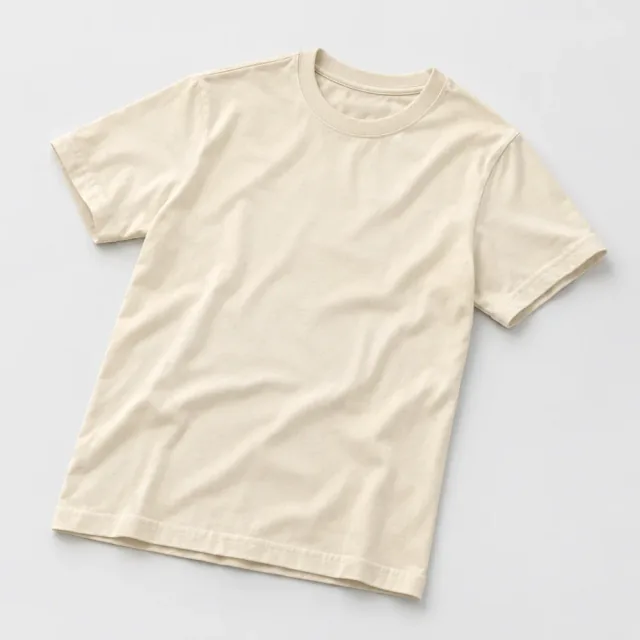
Cotton T-shirt
Plant fibres become yarn, then a flexible looped fabric.

Bound book
Paper becomes a durable sequence through its binding.
Follow the evidence
Original explanations informed by the sources below. Technical and industry sources support material behaviour; industry environmental marketing is not treated as a universal comparison. Read our editorial method.
- Scissors: materials and construction ↗Fiskars · Undated · Checked 2026-11-14
- Classic Professional Scissors: blade and pivot features ↗Fiskars · Undated · Checked 2026-11-14
- General principles for selection of stainless steels ↗British Stainless Steel Association · Undated · Checked 2026-11-13
- Recycling ↗worldstainless · Undated · Checked 2026-11-13
- What is steel? ↗World Steel Association · Undated · Checked 2026-11-13
- Raw materials ↗World Steel Association · Undated · Checked 2026-11-13