Microwave oven
A metal enclosure that contains waves while a window admits light.
A microwave oven contains electromagnetic energy inside a cooking cavity while letting the user see the food and operate controls. The metal cavity, screened door, turntable and electrical assemblies have distinct roles. This representative countertop example uses a coated steel enclosure and a glass turntable. It explains material selection without treating the appliance as a repair project: its electrical and shielding systems require specialist service.
Start with a part, then follow a material. No specialist knowledge needed.
Inside the object
Original conceptual illustration. Numbers open the component index; their positions are illustrative, not a disassembly guide. Equivalent text follows beside the diagram.
1Cooking cavity and outer case
Formed metal walls reflect microwave energy and provide a rigid enclosure. A cavity may use coated steel or stainless steel, depending on the model. The coating is a surface system rather than the source of the metal's shielding behaviour, and its condition still matters for intended use.
2Screened viewing door
A conductive metal screen permits visible light through small openings while strongly restricting microwaves at the operating wavelength. It works with the complete door structure, seals and latches. The transparent protective panes may be glass or polymer; the metal screen is not simply an ordinary window tint.
3Turntable and support ring
A model-specific glass plate rests on a roller support and rotates the food through the cavity's uneven field. Heat resistance, mechanical fit and the drive connection matter. The exact glass composition and support polymer are not assumed here, because a transparent tray alone does not identify either material.
Composition explained here; no separate material entry in this edition.
4Microwave source and power assembly
The magnetron generates microwaves, while a transformer or inverter and other electrical parts supply its operating conditions. Copper appears in conductors and windings within this system. That link identifies an electrical material role, not the full magnetron composition or a claim that the complete assembly is copper.
5Control panel and circuitry
A moulded control surround supports buttons or a display, while copper circuit paths and silicon semiconductor devices manage timing and power commands. ABS is a possible external housing polymer. Door interlocks are separate protective mechanisms: the display's apparent operation does not establish that those mechanisms are sound.
Why these materials?
The door presents an unusual materials puzzle: users need optical transparency, but the oven must contain much longer-wavelength radiation. A carefully designed metal screen and door system meet both requirements. Within the cavity, food absorbs energy non-uniformly, so rotation and standing time can help distribute heating. This is different from a conventional oven, where hot air and surfaces transfer much of the heat inward. Neither a shiny cavity nor a sophisticated touch panel explains the quality of the concealed electrical system or its protective interlocks.
One object, many versions.
Flatbed ovens use other ways of distributing energy and omit the familiar turntable. Combination ovens add convection or grill heating, changing acceptable cookware and temperature conditions. Cavity finishes also vary. Use the model's instructions for containers, cleaning and cooking; a material being transparent to microwaves does not automatically make a finished container suitable.
What happens after use?
A damaged door, latch or seal requires manufacturer or qualified-service advice, and an oven that operates with its door open should not be used. Do not open the appliance for material recovery or internal repair. At end of service, use an electrical-appliance recovery programme. Keep the glass tray out of bottle-glass recycling unless the collector explicitly accepts it.
Familiar things, connected.
Food-storage box
A rigid container meets a flexible seal at a carefully shaped edge.
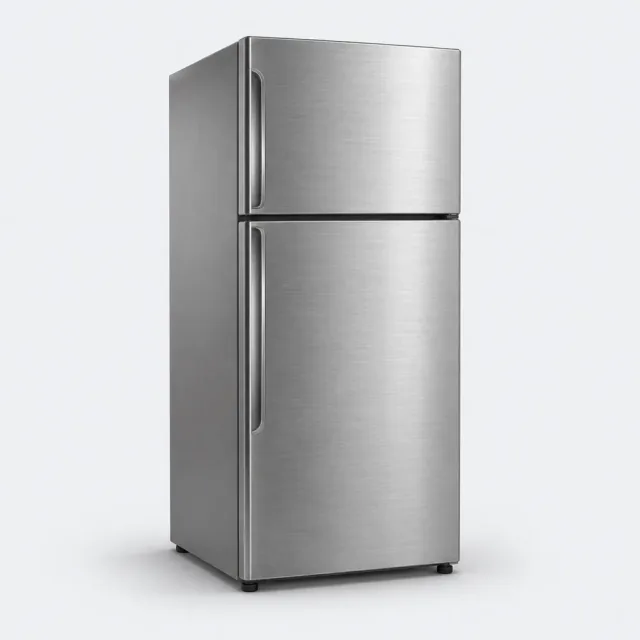
Refrigerator
A machine that moves heat, wrapped in materials that slow its return.

Electric kettle
Heat where it is useful, insulation where it is held.
Follow the evidence
Original explanations informed by the sources below. Technical and industry sources support material behaviour; industry environmental marketing is not treated as a universal comparison. Read our editorial method.
- Microwave ovens: operation and safe use ↗US Food and Drug Administration · Undated · Checked 2026-11-14
- Microwave: metal cavity ↗GE Appliances · Undated · Checked 2026-11-14
- What is steel? ↗World Steel Association · Undated · Checked 2026-11-13
- Raw materials ↗World Steel Association · Undated · Checked 2026-11-13
- General principles for selection of stainless steels ↗British Stainless Steel Association · Undated · Checked 2026-11-13
- Recycling ↗worldstainless · Undated · Checked 2026-11-13
- Mineral Commodity Summaries 2026 — Copper ↗U.S. Geological Survey, National Minerals Information Center · 2026-05-27 (version 1.3) · Checked 2026-11-13
- Copper Life Cycle ↗International Copper Association · Undated · Checked 2026-11-13
- Acrylonitrile Butadiene Styrene (ABS) and Other Specialist Styrenics ↗British Plastics Federation · Undated · Checked 2026-11-13
- Plastics Processes ↗British Plastics Federation · Undated · Checked 2026-11-13
- Silicon — element information, properties and uses ↗Royal Society of Chemistry · Undated · Checked 2026-11-13
- Mineral Commodity Summaries 2026 — Silicon ↗U.S. Geological Survey, National Minerals Information Center · 2026-05-27 (version 1.3) · Checked 2026-11-13
- Solar Photovoltaic Manufacturing Basics ↗U.S. Department of Energy · Undated · Checked 2026-11-13
- How Do I Recycle Common Recyclables ↗U.S. Environmental Protection Agency · Undated · Checked 2026-11-13