Refrigerator
A machine that moves heat, wrapped in materials that slow its return.
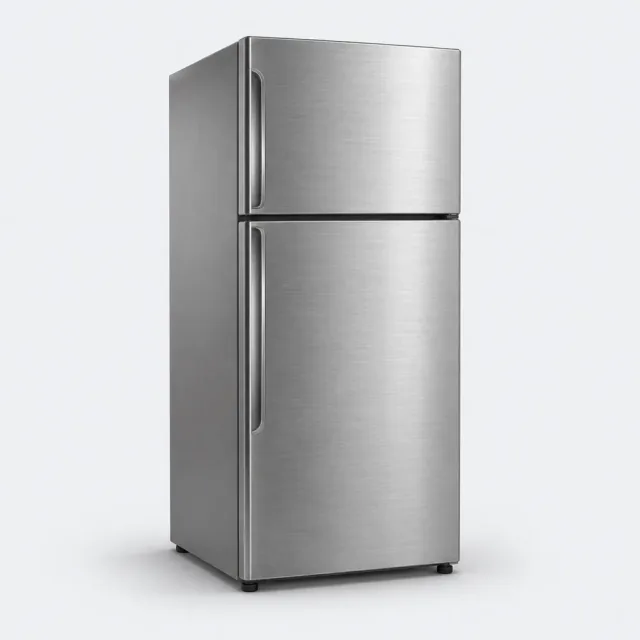
A refrigerator keeps food cool by moving heat from its interior to the surrounding room. Its materials support two complementary jobs: a sealed cooling circuit transfers heat, while insulated walls and a closing seal restrict heat entering again. This representative household refrigerator includes metal skins, a plastic liner and rigid foam. Refrigerant chemistry, heat-exchanger construction and electronic controls vary among models and over time.
Start with a part, then follow a material. No specialist knowledge needed.
Inside the object
Original conceptual illustration. Numbers open the component index; their positions are illustrative, not a disassembly guide. Equivalent text follows beside the diagram.
1Outer cabinet
Formed steel sheet gives the cabinet a stiff outer skin and supports doors, shelves and machinery through the assembly. Paint or other finishes protect the surface and control appearance. Stainless-steel decorative fronts exist, but a metallic-looking finish does not establish that all underlying cabinet parts are stainless steel.
2Inner liner
Thermoformed impact-modified polystyrene or ABS can make a smooth, shaped interior liner. These plastics allow rounded corners and shelf supports to be formed economically. The liner needs resistance to ordinary cleaning and food-contact conditions specified for the product; it is not the main layer providing thermal insulation.
3Insulating core
Rigid polyurethane foam fills much of the space between the cabinet skins. Its gas-filled cellular structure reduces heat transfer through the wall. Blowing agents and foam formulations differ by era and maker, so the foam’s identity alone does not reveal its complete climate impact or its disposal requirements.
4Heat exchangers and tubing
Copper tubing and aluminium heat-exchange surfaces are common examples within refrigeration systems, although steel and other constructions also occur. A sealed refrigerant circulates through the circuit and changes condition to move heat. The refrigerant is not represented by either metal entry and should not be released during disposal.
5Compressor and motor
A motor with copper windings drives the compressor that maintains the pressure differences required by the cooling cycle. Steel forms many mechanical parts and the sealed casing. Bearings, lubricating oil and electrical insulation also matter, so this is an assembly description rather than a complete list of its substances.
6Door gasket
A flexible PVC-based gasket is one common door-seal construction. Its profile accommodates the closing surfaces, and many designs include a magnetic insert that helps hold the door shut. Other elastomers are possible. A cracked or poorly fitting seal can allow warm air entry even when the compressor works correctly.
Why these materials?
A refrigerator combines conductive and insulating materials on purpose. Heat exchangers need to transfer thermal energy efficiently, while the cabinet walls should impede it. The motor supplies work to keep heat moving against the temperature difference between the cool compartment and the room. Better insulation can reduce operating demand but also occupies volume or requires a different wall design. Door seals, controls, airflow and user habits influence performance alongside the materials. Product energy ratings therefore describe tested appliances under defined conditions, rather than a universal efficiency associated with aluminium tubing or polyurethane foam.
One object, many versions.
Some refrigerators use natural refrigerants such as hydrocarbons, while others use fluorinated fluids; each requires its own system design and handling procedures. Vacuum insulation panels may supplement foam in some models. Absorption and thermoelectric coolers use different operating principles. The appearance of the cabinet cannot identify the refrigerant, blowing agent or energy performance of the unit.
What happens after use?
Repair and continued use should be considered alongside condition and operating efficiency. At retirement, use an approved appliance collection route that manages refrigerants and other controlled substances. Foam blowing agents may also require recovery, especially in older equipment. Do not cut tubing or dismantle the cooling system. Retailer take-back and municipal programs differ by location, so confirm that the destination handles refrigeration appliances appropriately.
Familiar things, connected.

Electric kettle
Heat where it is useful, insulation where it is held.
Washing machine
A wet working chamber inside a structural and electrical system.
Electric cable
A conductor is useful only when its current stays on the intended path.
Follow the evidence
Original explanations informed by the sources below. Technical and industry sources support material behaviour; industry environmental marketing is not treated as a universal comparison. Read our editorial method.
- More efficient production of refrigeration equipment ↗Covestro · Undated · Checked 2026-11-13
- Kitchen applications for styrenic polymers ↗INEOS Styrolution · Undated · Checked 2026-11-13
- Appliance Disposal ↗U.S. Environmental Protection Agency · Undated · Checked 2026-11-13
- Guidance Document for Foam Recovery from Refrigerators and Freezers ↗U.S. Environmental Protection Agency, Responsible Appliance Disposal Program · 2024-11 · Checked 2026-11-13
- What is steel? ↗World Steel Association · Undated · Checked 2026-11-13
- Raw materials ↗World Steel Association · Undated · Checked 2026-11-13
- Polystyrene ↗INEOS · Undated · Checked 2026-11-13
- Expanded and Extruded Polystyrene (EPS/XPS) ↗British Plastics Federation · Undated · Checked 2026-11-13
- Plastics Processes ↗British Plastics Federation · Undated · Checked 2026-11-13
- Acrylonitrile Butadiene Styrene (ABS) and Other Specialist Styrenics ↗British Plastics Federation · Undated · Checked 2026-11-13
- Plastics Processes ↗British Plastics Federation · Undated · Checked 2026-11-13
- Frequently asked questions on polyurethanes ↗ISOPA / Polyurethanes.org · Undated · Checked 2026-11-13
- The chemistry of polyurethanes ↗Danielle Williams, Lawrence Industries · Undated · Checked 2026-11-13
- Mineral Commodity Summaries 2026 — Copper ↗U.S. Geological Survey, National Minerals Information Center · 2026-05-27 (version 1.3) · Checked 2026-11-13
- Copper Life Cycle ↗International Copper Association · Undated · Checked 2026-11-13
- Aluminum Production and Processing ↗The Aluminum Association · Undated · Checked 2026-11-13
- Mineral Commodity Summaries 2026 — Aluminum ↗U.S. Geological Survey, National Minerals Information Center · 2026-05-27 (version 1.3) · Checked 2026-11-13
- Polyvinyl Chloride PVC ↗British Plastics Federation · Undated · Checked 2026-11-13