Acoustic guitar
A wooden resonator turns a string’s small motion into audible sound.
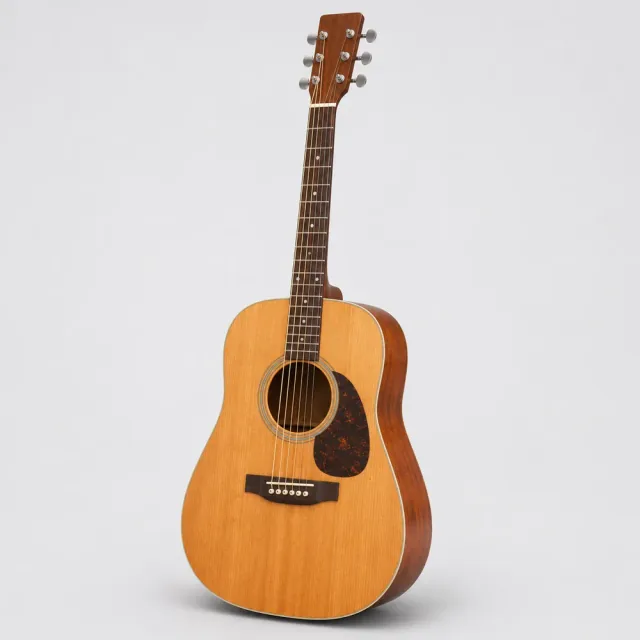
A steel-string acoustic guitar connects vibrating strings to a lightly built resonant body. The soundboard, braces and enclosed air interact to radiate sound, while the neck and tuning hardware hold the strings under tension. This representative instrument uses wood, some laminated panels and phosphor-bronze wound strings. Species, thickness, bracing and construction matter together; a list of expensive materials cannot predict the voice of a finished guitar.
Start with a part, then follow a material. No specialist knowledge needed.
Inside the object
Original conceptual illustration. Numbers open the component index; their positions are illustrative, not a disassembly guide. Equivalent text follows beside the diagram.
1Soundboard and braces
A wooden soundboard moves in response to forces transmitted through the bridge. Internal wood braces support it against string loading and influence its vibration. Grain direction, thickness and brace geometry matter alongside species, so a thin top is a carefully supported structure rather than simply a decorative lid.
2Back and sides
Back and side panels enclose the body and help define its shape and acoustic behaviour. They may use solid wood or laminated wood panels. Plywood’s bonded veneers provide a different construction from one solid board, and both approaches appear in instruments with varied performance and price.
3Neck and fingerboard
Wood forms the neck and often the fingerboard, while a steel truss rod is common in steel-string instruments to manage neck relief under string tension. The rod is not a routine substitute for good neck geometry. Adjustment belongs to the maker’s guidance or an experienced repairer.
4Strings
Plain steel strings and steel cores with phosphor-bronze windings are one common steel-string set. Winding adds mass without making the entire string a thick solid rod. Phosphor bronze is copper–tin based; some strings marketed as “80/20 bronze” instead use a copper–zinc alloy more accurately described as brass.
5Tuning machines
Small geared mechanisms allow controlled changes to string tension and hold the selected pitch. Brass gears and steel working parts are examples of materials used in such mechanisms. Tooth geometry, bearing support and friction influence tuning feel; the exterior plating does not identify all the metals inside.
6Frets
Many frets use nickel silver, a copper–nickel–zinc alloy that contains no necessary silver. Stainless-steel frets are another option. The standard nickel-silver alloy is outside this atlas’s current material entries, so it is named accurately rather than linked as if it were pure nickel or silver.
Composition explained here; no separate material entry in this edition.
Why these materials?
The strings alone move little air. Coupling their motion into a larger soundboard allows the instrument to radiate sound more effectively, but that board must also survive a sustained mechanical load. Stiffness, mass and damping interact, which is why geometry and joints are as important as the wood’s name. Laminated panels can change stability and manufacturing consistency; solid panels offer a different set of behaviours rather than an automatic guarantee of quality. Replaceable strings and serviceable tuning hardware allow common wear to be addressed without replacing the resonant body, provided the instrument remains structurally sound.
One object, many versions.
Classical guitars commonly use nylon-based treble strings and wound bass strings, with a construction designed for their loading. Electric guitars use pickups and electronics to convert string motion into an electrical signal. Steel-string acoustic guitars may use different woods, composites or laminates. String types and gauges should match the instrument; they are not interchangeable simply because they fit the tuning posts.
What happens after use?
Stable storage and appropriate maintenance can keep an instrument playable for decades. Follow maker guidance for humidity and cleaning, and use a repairer for structural damage or uncertain adjustments. A playable guitar can retain more value through reuse than as scrap. Broken instruments mix glued wood, finishes, metal and sometimes electronics, so disposal and material recovery depend on local services and the actual construction.
Familiar things, connected.

Follow the evidence
Original explanations informed by the sources below. Technical and industry sources support material behaviour; industry environmental marketing is not treated as a universal comparison. Read our editorial method.
- The Acoustic Guitar: Musical Instrument Guide ↗Yamaha · Undated · Checked 2026-11-13
- Acoustic Guitar: Choosing Strings ↗Yamaha · Undated · Checked 2026-11-13
- Learn & Earn: Acoustic Alloys ↗D’Addario · Undated · Checked 2026-11-13
- Earthwood 80/20 Bronze Acoustic Guitar Strings ↗Ernie Ball · Undated · Checked 2026-11-13
- Wood Handbook: Wood as an Engineering Material ↗USDA Forest Service, Forest Products Laboratory · 2021 (handbook revision) · Checked 2026-11-13
- Wood Handbook, Chapter 4: Moisture relations and physical properties of wood ↗Samuel V. Glass and Samuel L. Zelinka; USDA Forest Service · 2021-03 · Checked 2026-11-13
- Plywood ↗APA — The Engineered Wood Association · Undated · Checked 2026-11-13
- Wood Handbook, Chapter 11: Wood-Based Composite Materials ↗U.S. Forest Service, Forest Products Laboratory; Nicole M. Stark and Zhiyong Cai · 2021 · Checked 2026-11-13
- Sustainable Management of Construction and Demolition Materials ↗U.S. Environmental Protection Agency · Undated · Checked 2026-11-13
- What is steel? ↗World Steel Association · Undated · Checked 2026-11-13
- Raw materials ↗World Steel Association · Undated · Checked 2026-11-13
- Introduction to copper and copper alloys ↗Copper Information Center / International Copper Association · 2021-04-21 · Checked 2026-11-13
- Bronzes ↗Copper Information Center / International Copper Association · 2021-04-26 · Checked 2026-11-13
- Single Phosphor Bronze Wound Strings ↗D’Addario · Undated · Checked 2026-11-13
- Brasses ↗Copper Information Center / International Copper Association · 2021-04-29 · Checked 2026-11-13
- Preventing and Treating the Dezincification of Brass — CCI Notes 9/13 ↗Canadian Conservation Institute · Undated · Checked 2026-11-13