Headphones
A controlled movement becomes sound.
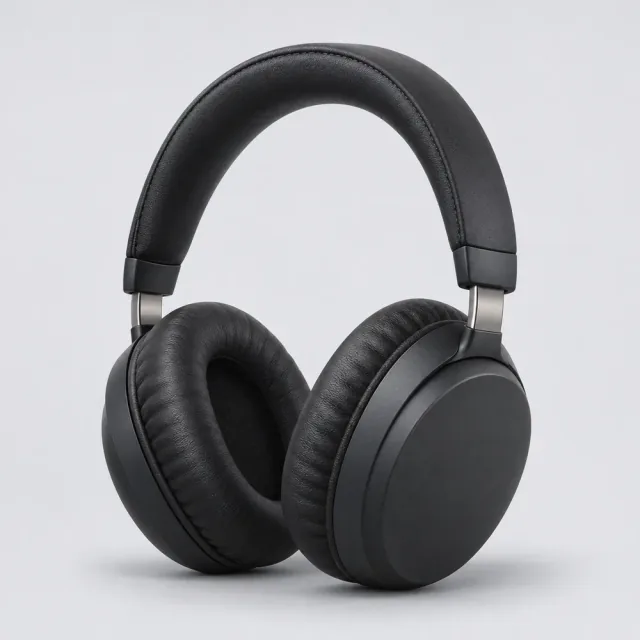
In a conventional dynamic headphone, an electrical signal moves a coil in a magnetic field. That motion drives a light diaphragm, creating pressure changes we hear as sound. The enclosure positions these components, while pads and a headband make the device wearable. This representative over-ear construction uses several material families. Wireless models add radio electronics and a battery; other driver technologies use different mechanisms and cannot be reduced to the same assembly.
Start with a part, then follow a material. No specialist knowledge needed.
Inside the object
Original conceptual illustration. Numbers open the component index; their positions are illustrative, not a disassembly guide. Equivalent text follows beside the diagram.
1Magnet
A neodymium-containing alloy can produce a strong magnetic field in a compact driver. It is a permanent-magnet material, not pure elemental neodymium. The magnetic circuit’s shape and its gap also affect operation, so a rare-earth ingredient alone does not establish sound quality or overall efficiency.
2Voice coil and diaphragm
A fine metal coil moves in the magnetic field and carries the diaphragm with it. Aluminium or copper-based conductors and thin polymer films are possible choices. Mass, stiffness and damping must work together; a heavier or more exotic material does not automatically reproduce sound more accurately.
3Cups and headband
Moulded polymer cups protect the driver and help define its acoustic space. A springy metal band or reinforced polymer structure provides clamping force. Open-backed cups deliberately let air and sound pass; closed-backed designs manage the enclosed air differently. The enclosure is therefore part of the acoustic design.
4Pads and cable
Foam pads cushion the contact area and help set the acoustic seal; polyurethane is one common foam family. Conducting copper wires need insulation, which may use PVC or other polymers. Replaceable pads and cables can extend service life without replacing the working driver assembly.
Why these materials?
A driver turns electricity into motion, but the surrounding materials determine how that motion reaches the ear. Pad stiffness and leakage alter the enclosed air volume. The diaphragm should move as intended without excessive unwanted vibration. A light coil can help reduce moving mass, yet it must carry current and withstand heating. Strong magnets make compact designs possible without guaranteeing a preferred listening experience. Repairability is another design property: accessible pads, cables and fasteners can preserve the functional assembly when a small wearing part fails.
One object, many versions.
Planar magnetic and electrostatic headphones use different conductor and diaphragm arrangements. Earbuds also change the enclosure, fitting parts and scale. Wireless headphones include a lithium-ion cell and circuit boards; wired models may contain no battery at all. The exact plastic, pad covering and coil conductor often vary within a product family, so this diagram is a representative explanation.
What happens after use?
Replaceable pads, cables and batteries can be useful service parts when the manufacturer provides a safe route. Donate a working pair only when hygienic and functional. Broken headphones belong in an appropriate electronics collection scheme where available. Wireless batteries require particular care: the complete device should not enter ordinary mixed recycling, and glued cells should not be pried out by an untrained owner.
Put the choices side by side.
Familiar things, connected.
Follow the evidence
Original explanations informed by the sources below. Technical and industry sources support material behaviour; industry environmental marketing is not treated as a universal comparison. Read our editorial method.
- HD 480 PRO: driver and replaceable components ↗Sennheiser · Undated · Checked 2026-11-13
- A World of Minerals in Your Mobile Device ↗U.S. Geological Survey · 2016-09 · Checked 2026-11-13
- Used Lithium-Ion Batteries ↗U.S. Environmental Protection Agency · Undated · Checked 2026-11-13
- Introducing the HD 620S: aluminium voice coil construction ↗Sennheiser / Sonova Consumer Hearing · 2024-05-08 · Checked 2026-11-13
- Neodymium — element information, properties and uses ↗Royal Society of Chemistry · Undated · Checked 2026-11-13
- Mineral Commodity Summaries 2026 — Rare Earths ↗U.S. Geological Survey, National Minerals Information Center · 2026-05-27 (version 1.3) · Checked 2026-11-13
- How Do I Recycle Common Recyclables ↗U.S. Environmental Protection Agency · Undated · Checked 2026-11-13
- Aluminum Production and Processing ↗The Aluminum Association · Undated · Checked 2026-11-13
- Mineral Commodity Summaries 2026 — Aluminum ↗U.S. Geological Survey, National Minerals Information Center · 2026-05-27 (version 1.3) · Checked 2026-11-13
- Mineral Commodity Summaries 2026 — Copper ↗U.S. Geological Survey, National Minerals Information Center · 2026-05-27 (version 1.3) · Checked 2026-11-13
- Copper Life Cycle ↗International Copper Association · Undated · Checked 2026-11-13
- Polyesters (Thermoplastic) PETP, PBT, PET ↗British Plastics Federation · Undated · Checked 2026-11-13
- Melt Spinning ↗Textile Exchange · Undated · Checked 2026-11-13
- Microplastics from textiles: towards a circular economy for textiles in Europe ↗European Environment Agency · 2022 · Checked 2026-11-13
- Acrylonitrile Butadiene Styrene (ABS) and Other Specialist Styrenics ↗British Plastics Federation · Undated · Checked 2026-11-13
- Plastics Processes ↗British Plastics Federation · Undated · Checked 2026-11-13
- Polycarbonate (PC) ↗British Plastics Federation · Undated · Checked 2026-11-13
- General principles for selection of stainless steels ↗British Stainless Steel Association · Undated · Checked 2026-11-13
- Recycling ↗worldstainless · Undated · Checked 2026-11-13
- Frequently asked questions on polyurethanes ↗ISOPA / Polyurethanes.org · Undated · Checked 2026-11-13
- The chemistry of polyurethanes ↗Danielle Williams, Lawrence Industries · Undated · Checked 2026-11-13
- Polyvinyl Chloride PVC ↗British Plastics Federation · Undated · Checked 2026-11-13