Football
The outer panels and the air chamber solve different problems.
An association football is an inflated assembly whose outer skin, reinforcement and bladder have separate jobs. The cover must tolerate impacts and abrasion, while the inner chamber must retain air. This example follows a stitched and bonded polyurethane-covered ball with polyester backing and a butyl bladder. It does not describe every match ball: panel patterns, joining methods and bladder compounds vary substantially between models.
Start with a part, then follow a material. No specialist knowledge needed.
Inside the object
Original conceptual illustration. Numbers open the component index; their positions are illustrative, not a disassembly guide. Equivalent text follows beside the diagram.
1Outer cover
A polyurethane surface gives the ball a durable contact skin that can be textured for handling and flight behaviour. Beneath it, cushioning layers may modify feel. Calling the cover polyurethane does not establish the chemistry of every foam or adhesive inside the panel.
2Reinforcing panel backing
Polyester textile reinforcement helps restrain the panels against internal pressure and repeated impacts. Its orientation and connection to the cover influence dimensional stability. Foam can be included in the panel assembly, but a product description must identify its chemistry before it is assigned a specific polymer.
3Panel joins
Stitching and adhesive bonding are combined in some balls to secure the panel edges. Polyester is a common durable sewing-thread option. Joint design matters because the inflated ball repeatedly loads these boundaries; the surface pattern is therefore a construction choice as well as a visual one.
4Bladder and inflation valve
A butyl-rubber bladder is used in the representative construction to retain air inside the cover. Butyl is a synthetic rubber distinct from natural rubber and is not currently indexed separately in this atlas. The valve must admit an inflation needle and then reseal reliably.
Composition explained here; no separate material entry in this edition.
Why these materials?
Air pressure gives the ball much of its shape and rebound, but the enclosing materials control how that pressure is maintained. The outer panel structure limits expansion; the bladder supplies an air barrier; and the joints keep the cover continuous. The spherical form can be assembled from different panel arrangements, so a familiar pattern is not a universal specification. Abrasion of the cover, leakage through a valve and a failed seam are different problems, even when all three leave the ball unpleasant to use.
One object, many versions.
Some balls use natural-latex bladders, while others use synthetic rubber systems. Thermally bonded, hand-stitched and hybrid joins differ, as do panel count and cushioning. Futsal balls have different rebound requirements from outdoor association footballs. Material comparisons should therefore stay within the intended sport, product class and stated inflation range.
What happens after use?
Keep the ball within its marked inflation range and follow the maker's valve and cleaning instructions. Check for damage before continued play. A usable ball can be passed on to another player or organisation that accepts it. Mixed bonded panels and a separate bladder make routine household recycling difficult; use a specific sports-equipment collection scheme where one is available.
Familiar things, connected.
Tennis racket
A stiff frame carries a deliberately flexible string bed.
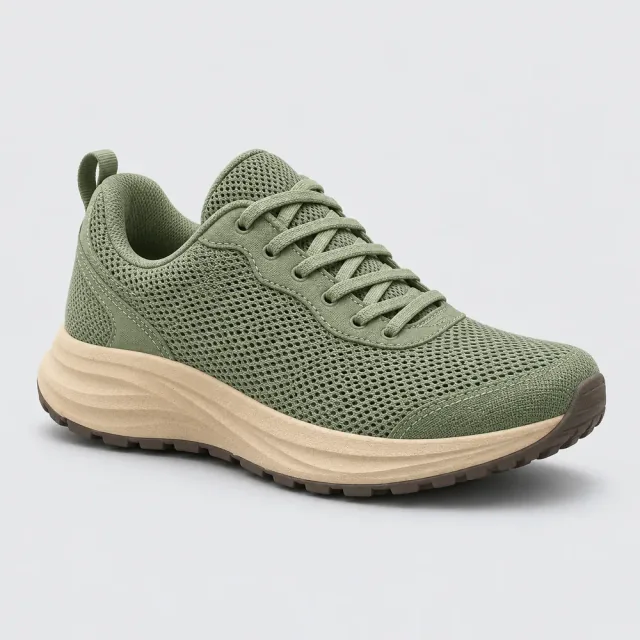
Running shoe
A hard-wearing surface, a soft middle, a flexible shell.
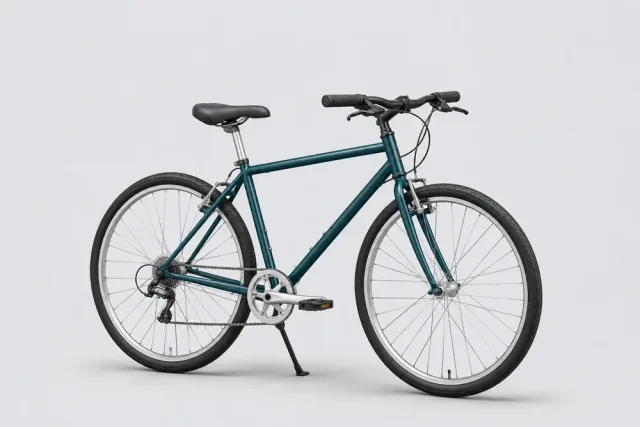
Bicycle
Strength depends on shape as well as substance.
Follow the evidence
Original explanations informed by the sources below. Technical and industry sources support material behaviour; industry environmental marketing is not treated as a universal comparison. Read our editorial method.
- X-Turf football — material and construction specifications ↗SELECT Sport · Undated · Checked 2026-11-14
- SELECT Lab — football construction ↗SELECT Sport · Undated · Checked 2026-11-14
- Coats Epic ↗Coats Group · Undated · Checked 2026-11-14
- Sports Balls ↗Coats Group · Undated · Checked 2026-11-14
- Frequently asked questions on polyurethanes ↗ISOPA / Polyurethanes.org · Undated · Checked 2026-11-13
- The chemistry of polyurethanes ↗Danielle Williams, Lawrence Industries · Undated · Checked 2026-11-13
- Polyesters (Thermoplastic) PETP, PBT, PET ↗British Plastics Federation · Undated · Checked 2026-11-13
- Melt Spinning ↗Textile Exchange · Undated · Checked 2026-11-13
- Microplastics from textiles: towards a circular economy for textiles in Europe ↗European Environment Agency · 2022 · Checked 2026-11-13