Glass aquarium
Clear walls become a water-holding structure at their joints.
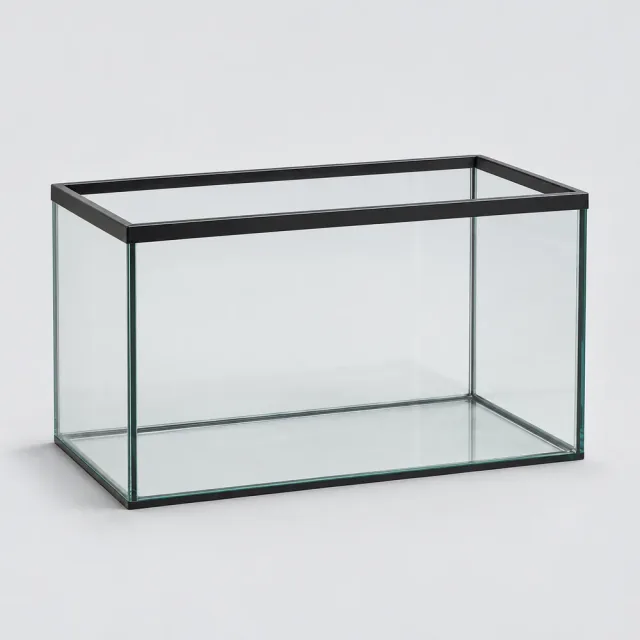
A glass aquarium is a pressure-containing vessel built from flat transparent panels. The water loads its walls continuously, so glass thickness, support and joint design belong to one structural system. This representative rectangular tank uses soda-lime glass, silicone joints and a separate glass cover. It focuses on the vessel itself; pumps, heaters, lighting and the biological system require additional materials and their own equipment guidance.
Start with a part, then follow a material. No specialist knowledge needed.
Inside the object
Original conceptual illustration. Numbers open the component index; their positions are illustrative, not a disassembly guide. Equivalent text follows beside the diagram.
1Side panels
Flat soda-lime glass lets light pass while providing comparatively stiff walls. The panels bend slightly under water pressure, which increases with depth. Glass thickness and edge condition therefore matter to the designed vessel; transparency alone tells little about whether a particular sheet is suitable for an aquarium.
2Base panel
The glass base closes the vessel and transfers loads through the support arrangement specified for that aquarium. It is a structural part, not merely a decorative bottom. Some models require full support and others a particular perimeter support, so instructions cannot be inferred from the material name.
3Bonded seams
An appropriate cured silicone adhesive bonds adjoining panels and seals the joints while accommodating some movement. Aquarium joints depend on the adhesive formulation, bonded area, preparation and manufacturing control. Household sealants are not automatically interchangeable with structural aquarium products, even if both are labelled silicone.
4Top bracing
Some glass aquariums include glass braces that help restrain movement of the long panels. Their dimensions and attachment are part of the original design. Frameless, rimmed and braced constructions use different load paths, so removing an apparently unnecessary strip can change the stresses on the vessel.
5Cover and hinge
A glass cover can reduce evaporation and help keep animals inside while admitting light. Some commercial covers use a flexible silicone hinge to allow access. The lid is distinct from structural bracing: a removable cover should not be assumed to reinforce the walls or support added loads.
Why these materials?
Aquarium design turns a brittle material into a durable container by controlling its stresses and protecting its edges. The glass provides stiffness, while a suitably designed silicone joint accommodates movement and keeps water from escaping. A larger tank is not simply a small tank scaled up with the same sheet thickness: water depth and panel span alter the loads and bending. The support furniture also participates in the system. Clear joints and minimal framing can make the vessel look simple, but reliable construction depends on dimensions, workmanship and a specified support arrangement that the viewer cannot judge from appearance alone.
One object, many versions.
Acrylic aquariums use PMMA panels and different bonding methods. They can be lighter for a given design and easier to form into curves, but scratch behaviour, stiffness and long-term loading differ from glass. Some tanks have polymer or metal rims. Neither acrylic nor glass is universally superior without considering size, geometry, maintenance and the engineered assembly.
What happens after use?
A sound tank may be reused after appropriate assessment and cleaning for its intended purpose. Cracks, damaged edges or questionable seams require manufacturer or qualified professional guidance, not cosmetic repair assumptions. Ordinary container-glass collection usually excludes aquarium panels, and attached silicone adds another separation problem. Confirm a local route for flat glass and handle retired panels through a service equipped for their size and sharp edges.
Familiar things, connected.

Follow the evidence
Original explanations informed by the sources below. Technical and industry sources support material behaviour; industry environmental marketing is not treated as a universal comparison. Read our editorial method.
- Standard Glass Aquariums ↗Aquael · Undated · Checked 2026-11-13
- Frameless Cube Aquariums ↗Aqueon · Undated · Checked 2026-11-13
- Glass Tops ↗Aqueon · Undated · Checked 2026-11-13
- How we make glass: chemistry of glass ↗Pilkington / NSG Group · Undated · Checked 2026-11-13
- About glass ↗British Glass · Undated · Checked 2026-11-13
- Quality of recycling: Towards a reference framework for the circular economy ↗European Commission Joint Research Centre · 2020 · Checked 2026-11-13
- Room Temperature Vulcanizing (RTV) Silicones: Material and Processing Guidelines ↗WACKER Chemie · Undated · Checked 2026-11-13
- Products & Services — Annual Report 2025 ↗WACKER Chemie · 2026 (report for 2025) · Checked 2026-11-13