Cement
Cement is a binder, not a synonym for concrete. This entry focuses on Portland cement and related blended cements, whose reactive mineral phases develop binding products when mixed with water. Sand, coarse aggregate and other ingredients turn that binder into mortars or concretes with different jobs. The powder’s composition and fineness influence setting and strength development, while the hardened product depends just as strongly on proportions, placement and curing.
Useful properties
Why it earns its placeA binding matrix ↗
Hydration products form a connected paste that binds aggregate into mortar or concrete; interface quality matters.
Workable before setting ↗
Water creates a paste that can be distributed and shaped before chemical reactions establish a rigid structure.
Strength develops with hydration ↗
A cementitious system gains strength as reactions proceed, with water content, temperature and curing conditions influencing the result.
From input to useful material.
A simplified industrial pathway. Select a stage to learn what changes. Recycled feedstock and other process variants can enter at different stages.
Origins & processing
Portland cement manufacture begins with calcium-rich raw material, commonly limestone, combined with sources of silica, alumina and iron. The prepared raw mix passes through high-temperature processing: carbonate decomposition releases carbon dioxide and subsequent reactions form clinker minerals. After cooling, clinker is ground with a controlled sulfate addition, often gypsum, and any permitted additional constituents. Blended products incorporate other specified materials. The result is a carefully engineered powder rather than ground natural rock, and cement types should not be assumed to have identical chemistry.
Where it turns up
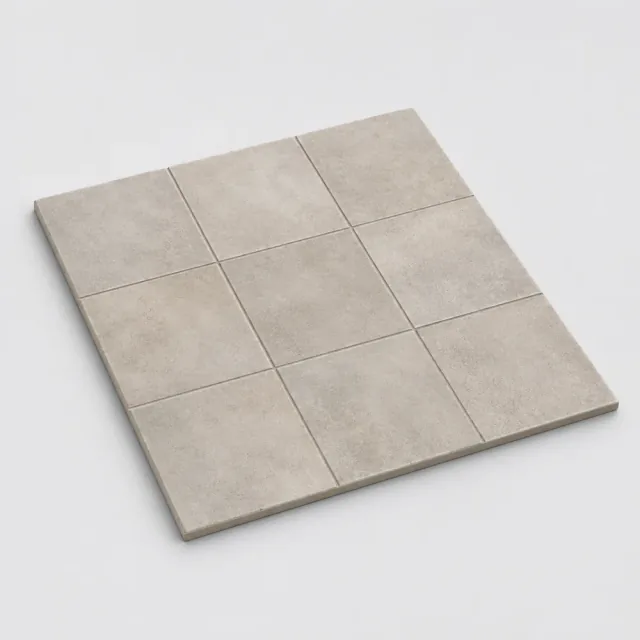
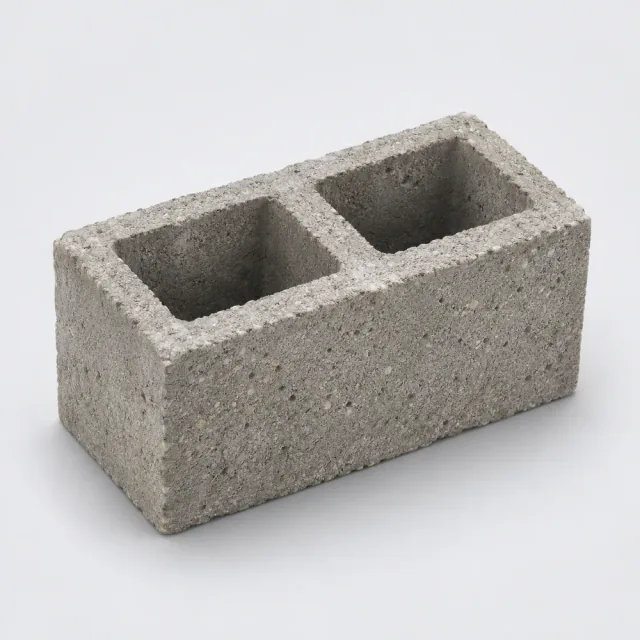
Cement binds the aggregate in concrete blocks and structural concrete, and combines with finer aggregate in many mortars. Some tile adhesives are cement-based formulations with polymer and other additions, while other adhesives use different chemistry. The cement is a reactive ingredient in these systems, not necessarily a distinct visible layer that can be removed after the product has hardened.
Useful, with limits.
Clinker manufacture requires heat and releases carbon dioxide from the raw minerals as well as from some energy sources. Different blends can change these impacts and performance, but they need application-specific design. Wet cementitious mixtures are strongly alkaline and require appropriate handling. Poor curing, unsuitable water content or an incorrect binder selection can undermine a finished product even when the bagged cement meets its specification.
A next life depends on the system.
Unused dry cement must be protected from moisture because premature reaction reduces its usefulness. Once hydrated in mortar or concrete, it cannot simply be dried back into the original binder. Demolition recovery more commonly produces recycled aggregate than new cement powder. Research and industrial recovery routes continue to develop, but a specific facility and feedstock specification are needed before promising a closed material cycle.
Familiar things, connected.
Follow the evidence
Original explanations informed by the sources below. Technical and industry sources support material behaviour; industry environmental marketing is not treated as a universal comparison. Browse the source register.
- The making of portland cement ↗American Concrete Institute · Undated · Checked 2026-11-13
- How Cement Is Made ↗American Cement Association · Undated · Checked 2026-11-13
- Explained: Cement vs. concrete — their differences, and opportunities for sustainability ↗MIT Concrete Sustainability Hub; Andrew Logan · 2020-04-03 · Checked 2026-11-13
- Sustainable Management of Construction and Demolition Materials ↗U.S. Environmental Protection Agency · Undated · Checked 2026-11-13