Carbon-fibre composite
Carbon-fibre reinforced polymer combines stiff fibres with a surrounding resin matrix. The fibres carry much of the load; the matrix holds them in place, transfers forces and protects them. Fibre direction is a design choice, so a part can be strong in one direction and less capable in another. A carbon bicycle frame is therefore an engineered layup, not a uniform block of a material called carbon.
Useful properties
Why it earns its placeFrom input to useful material.
A simplified industrial pathway. Select a stage to learn what changes. Recycled feedstock and other process variants can enter at different stages.
Origins & processing
Many carbon fibres start as polyacrylonitrile precursor fibres, which undergo controlled heating and carbonization. Surface treatment and sizing help them bond with a matrix. Fibres can be arranged as tapes, fabrics or other forms, combined with resin, placed in a mould and consolidated. Thermoset matrices such as epoxy cure into a network; thermoplastic composites follow other routes. Inspection and process control are important because voids, misalignment and incomplete bonding can alter performance. The manufacturing structure is part of the material specification.
Where it turns up
Some bicycle frames and components use carbon-fibre composites to tailor stiffness and mass. Other uses include sporting goods and engineered structures. A cosmetic carbon-pattern surface does not demonstrate structural carbon reinforcement. Even genuine fibre composites differ by fibre grade, matrix, orientation and manufacturing quality, so appearance is an incomplete guide.
Useful, with limits.
Impact can damage internal layers without obvious surface deformation. Loads across the fibres or at joints need careful design. Thermoset matrices make separation difficult, and carbon-fibre production involves demanding thermal processing. A lightweight component’s benefits depend on its use and lifetime; no universal environmental ranking follows from low mass alone.
A next life depends on the system.
Specialist repair may be possible after appropriate assessment, but safety-critical parts need qualified judgement. Recycling can recover fibres from suitable composites, though fibre length, surface condition and matrix recovery vary. Collection is not equivalent to returning an old frame to an identical new one. Conventional household plastic recycling is not an appropriate assumed route.
Familiar things, connected.
Tennis racket
A stiff frame carries a deliberately flexible string bed.
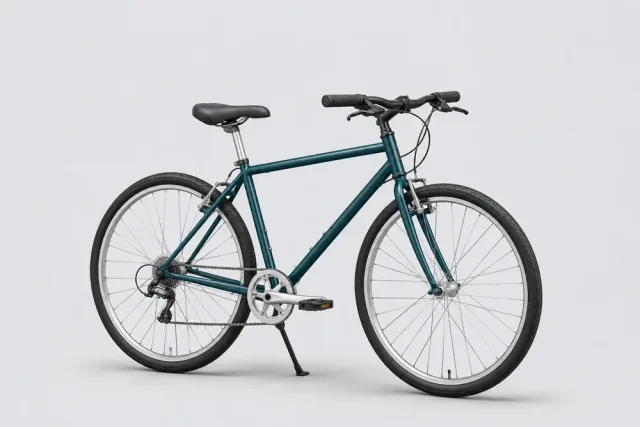
Bicycle
Strength depends on shape as well as substance.
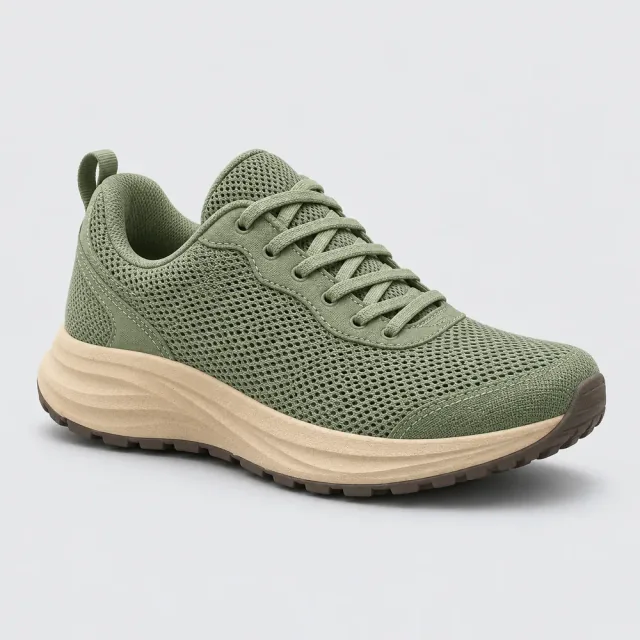
Running shoe
A hard-wearing surface, a soft middle, a flexible shell.
Follow the evidence
Original explanations informed by the sources below. Technical and industry sources support material behaviour; industry environmental marketing is not treated as a universal comparison. Read our editorial method.
- Composite materials: Materials ↗Composites UK · Undated · Checked 2026-11-13
- Plasma Oxidation of Carbon Fiber Precursor ↗U.S. Department of Energy · 2016-06-23 · Checked 2026-11-13
- End of Life and Recycling ↗Composites UK · Undated · Checked 2026-11-13