LED lamp
Making light still leaves heat to manage.
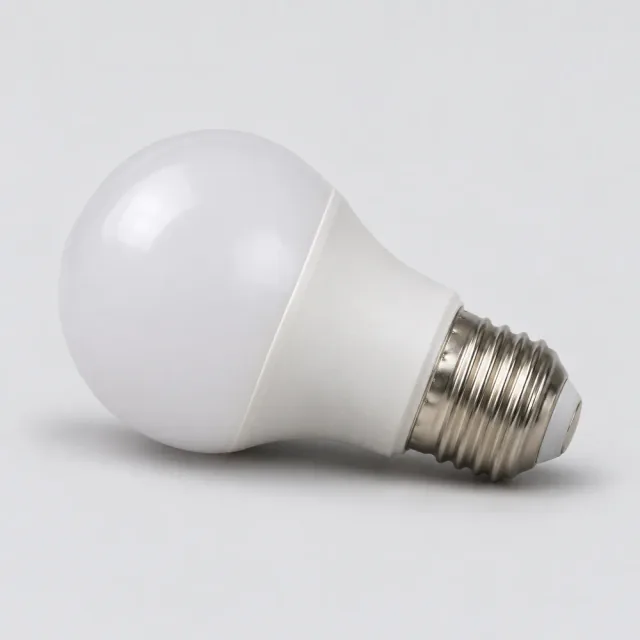
An LED lamp is an electronic assembly, even when it has the familiar outline of a light bulb. Semiconductor devices produce light, a driver manages their electrical supply, and a thermal path carries away heat. A diffuser changes how the light reaches the room. This representative mains-powered lamp explains those functions without prescribing a specific circuit. Filament-style lamps and integrated luminaires can package them in noticeably different ways.
Start with a part, then follow a material. No specialist knowledge needed.
Inside the object
Original conceptual illustration. Numbers open the component index; their positions are illustrative, not a disassembly guide. Equivalent text follows beside the diagram.
1Light-emitting package
The light-emitting semiconductor commonly uses compounds such as gallium nitride rather than ordinary silicon. Many white LEDs combine a blue emitter with light-converting phosphors. Encapsulants and package materials support the tiny device. These compounds are outside this release’s material index and are not incorrectly linked to a silicon chip.
Composition explained here; no separate material entry in this edition.
2Driver board
Electronic components regulate or convert the electrical supply for the LEDs. Silicon devices, copper conductors and an insulating circuit board may be present. A typical board can use glass fibre and epoxy, but substrate construction varies. The driver is a separate functional assembly from the light-emitting semiconductor.
3Heat-spreading structure
An aluminium heat spreader or heat sink can conduct heat away from the LED package toward the surrounding air. The path through interfaces and housing matters as well as the metal. Not every lamp has a visibly finned heatsink, and polymer housings can conceal an internal thermal structure.
4Diffuser
A translucent polycarbonate cover or suitable glass envelope can spread the small bright sources into a more useful apparent light area. Optical additives, surface texture and shape influence distribution. The cover also contributes to enclosure protection; it is not necessarily interchangeable with any similarly shaped transparent material.
5Base and insulation
A screw base may use aluminium or another suitable conductor, with insulating regions separating electrical contacts. Pin and bayonet versions have different geometry. The socket interface carries both mechanical and electrical duties, making the complete lamp rating and fixture compatibility more meaningful than its outline alone.
Why these materials?
LEDs turn more of their electrical input into visible light than traditional incandescent lamps, but they still produce heat that must leave the semiconductor. Poor thermal conditions can reduce output and life. A lamp can also fail because its driver or another component fails before the LED itself stops emitting. This makes the enclosure, thermal path and electronics part of the lighting system rather than mere packaging. A replaceable lamp and a sealed integrated fitting may have different repair options even when their light sources use similar semiconductor technology.
One object, many versions.
Filament-style LED lamps distribute emitters along narrow supports inside a bulb-shaped envelope. Other lamps use a compact circuit board and diffuser. Integrated fittings may use larger aluminium bodies and replaceable or non-replaceable drivers. Dimming, enclosure and temperature compatibility depend on the specific product. A visually matching base alone does not establish suitability for every electrical fixture.
What happens after use?
Replace a failed lamp with a compatible product following fixture and manufacturer instructions, and disconnect power as appropriate. LED lamps are electronic waste, not ordinary container glass, even when the outer envelope is glass. Use local lamp or electronics collection options where available. Do not open mains-powered lamp electronics to harvest materials; internal parts and stored electrical energy require competent handling.
Familiar things, connected.
Follow the evidence
Original explanations informed by the sources below. Technical and industry sources support material behaviour; industry environmental marketing is not treated as a universal comparison. Browse the source register.
- Learn about LED lighting ↗ENERGY STAR / U.S. Environmental Protection Agency · Undated · Checked 2026-11-13
- High-efficiency lighting ↗Pacific Northwest National Laboratory · Undated · Checked 2026-11-13
- LED VALUE CLASSIC A product datasheet ↗LEDVANCE · Undated · Checked 2026-11-13
- Silicon — element information, properties and uses ↗Royal Society of Chemistry · Undated · Checked 2026-11-13
- Mineral Commodity Summaries 2026 — Silicon ↗U.S. Geological Survey, National Minerals Information Center · 2026-05-27 (version 1.3) · Checked 2026-11-13
- Solar Photovoltaic Manufacturing Basics ↗U.S. Department of Energy · Undated · Checked 2026-11-13
- How Do I Recycle Common Recyclables ↗U.S. Environmental Protection Agency · Undated · Checked 2026-11-13
- Mineral Commodity Summaries 2026 — Copper ↗U.S. Geological Survey, National Minerals Information Center · 2026-05-27 (version 1.3) · Checked 2026-11-13
- Copper Life Cycle ↗International Copper Association · Undated · Checked 2026-11-13
- Composite materials: Materials ↗Composites UK · Undated · Checked 2026-11-13
- Guidelines and Recommended Practices for Fiber-Reinforced-Polymer Architectural Products ↗American Composites Manufacturers Association · 2016 · Checked 2026-11-13
- End of Life and Recycling ↗Composites UK · Undated · Checked 2026-11-13
- Epoxies EP ↗British Plastics Federation · Undated · Checked 2026-11-13
- Aluminum Production and Processing ↗The Aluminum Association · Undated · Checked 2026-11-13
- Mineral Commodity Summaries 2026 — Aluminum ↗U.S. Geological Survey, National Minerals Information Center · 2026-05-27 (version 1.3) · Checked 2026-11-13
- Polycarbonate (PC) ↗British Plastics Federation · Undated · Checked 2026-11-13
- Plastics Processes ↗British Plastics Federation · Undated · Checked 2026-11-13
- How we make glass: chemistry of glass ↗Pilkington / NSG Group · Undated · Checked 2026-11-13
- About glass ↗British Glass · Undated · Checked 2026-11-13
- Quality of recycling: Towards a reference framework for the circular economy ↗European Commission Joint Research Centre · 2020 · Checked 2026-11-13