Titanium
Titanium is used when a designer values a combination of strength, moderate density and corrosion resistance enough to justify demanding processing. A thin oxide film helps protect the surface. Titanium alloys can appear in bicycle frames and spectacle frames, but many superficially similar products use steel or aluminium instead. Titanium metal must also be distinguished from titanium dioxide, the white pigment used in many paints and plastics.
Useful properties
Why it earns its placeFrom input to useful material.
A simplified industrial pathway. Select a stage to learn what changes. Recycled feedstock and other process variants can enter at different stages.
Origins & processing
Titanium-bearing minerals such as ilmenite and rutile provide raw material for several industries. Producing metal requires a sequence of chemical conversion and reduction, followed by consolidation and melting under controlled conditions. Forming, joining and machining are demanding because the metal reacts strongly with some surrounding gases at elevated temperatures. Alloy additions tune its properties. Most titanium-mineral use is associated with pigment rather than metal, so mineral-concentrate statistics cannot be labelled bicycle-frame titanium production.
Where it turns up
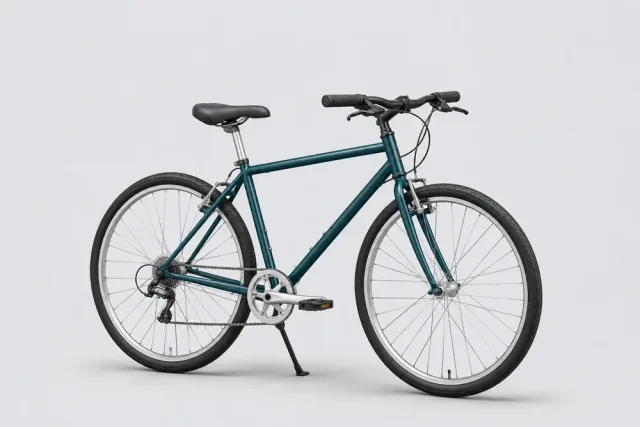
Some premium bicycle frames and spectacle frames use titanium or titanium alloys. Other applications include medical and aerospace components with tightly controlled specifications. These uses share broad material advantages but have very different qualification requirements. A colour, weight impression or marketing name cannot by itself identify the alloy or its grade.
Useful, with limits.
Titanium is not the lightest metal, and the mass of a finished frame also depends on stiffness, geometry and joints. Processing and fabrication cost can be high. Corrosion resistance is conditional, while wear and joining can need special attention. A material choice that works in one product cannot be transferred to a safety-critical component without engineering assessment.
A next life depends on the system.
Clean titanium manufacturing scrap has established value, while small mixed consumer components are harder to identify and collect. Specialist metal recyclers may accept them, but household packaging streams are not a universal route. Keep a sound frame or pair of spectacles in use where practical. Alloy identification helps preserve value when recycling is available.
Familiar things, connected.

Spectacle frames
Small components balance stiffness, flexibility and comfort.
Bicycle
Strength depends on shape as well as substance.

Mobile phone
A small meeting place for very different materials.
Follow the evidence
Original explanations informed by the sources below. Technical and industry sources support material behaviour; industry environmental marketing is not treated as a universal comparison. Read our editorial method.
- Titanium — element information, properties and uses ↗Royal Society of Chemistry · Undated · Checked 2026-11-13
- Mineral Commodity Summaries 2026 — Titanium ↗U.S. Geological Survey, National Minerals Information Center · 2026-05-27 (version 1.3) · Checked 2026-11-13