Porcelain
Porcelain begins as a workable mixture of mineral ingredients and becomes a hard ceramic through firing. Traditional hard-paste recipes use kaolin, feldspar and quartz, with formulations adjusted for the intended object. The fired body includes crystalline and glassy phases rather than remaining a compacted lump of clay. Its dense, often white body can support thin walls and a smooth glazed surface, which helps explain its long use in tableware.
Useful properties
Why it earns its placeFrom input to useful material.
A simplified industrial pathway. Select a stage to learn what changes. Recycled feedstock and other process variants can enter at different stages.
Origins & processing
Clay minerals provide shaping behaviour, while feldspar and silica-bearing ingredients help establish the fired structure. Producers prepare and mix the powders, form the body, dry it and fire it under controlled conditions. Glazing adds another material whose expansion and chemistry must be compatible with the body. Porcelain recipes and firing schedules vary; bone china and stoneware are related but distinct categories. The final properties depend on the firing and defects as well as the names of the starting minerals.
Where it turns up
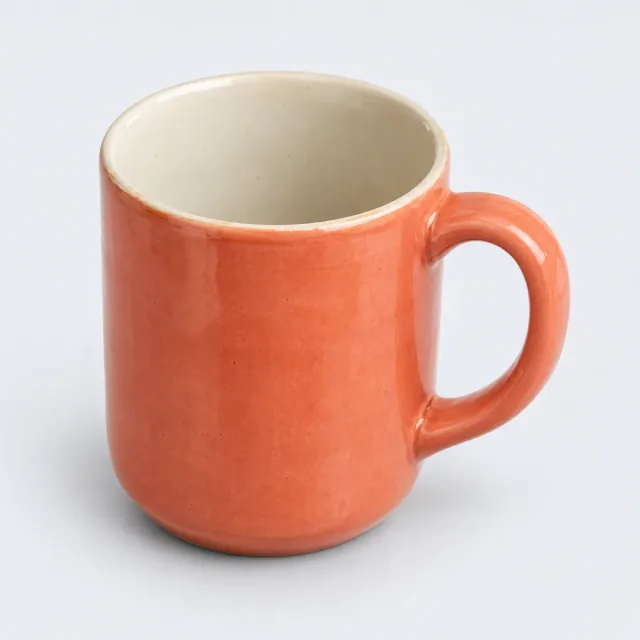
A mug uses porcelain to hold a drink in a rigid, cleanable shape. Specialist porcelain also serves electrical insulation, where composition and testing are selected for different demands. Decorative ceramic surfaces may contain pigments and glazes that are separate from the body. A white appearance alone is not enough to identify porcelain.
Useful, with limits.
Hardness comes with brittleness: a chip or crack can make an otherwise substantial object fail. Thermal shock depends on geometry and temperature change. Food-contact suitability concerns the finished body, glaze and decoration, not just the word ceramic. An old or decorative vessel should not be assumed suitable for hot drinks without appropriate product information.
A next life depends on the system.
Porcelain does not melt and behave like container glass in a recycling furnace, so it should stay out of bottle-and-jar streams. Some construction or specialist routes can use ceramic fragments as aggregate, but household access varies. Keeping sound tableware in use is usually straightforward. Broken pieces need handling and disposal according to local guidance.
Familiar things, connected.
Follow the evidence
Original explanations informed by the sources below. Technical and industry sources support material behaviour; industry environmental marketing is not treated as a universal comparison. Read our editorial method.
- Holistic health: How ceramics and glass contribute to our physical and mental wellbeing ↗The American Ceramic Society · Undated · Checked 2026-11-13
- Rivalry and Dresden plates and quilts: European porcelain production ↗The American Ceramic Society · Undated · Checked 2026-11-13
- Quality of recycling: Towards a reference framework for the circular economy ↗European Commission Joint Research Centre · 2020 · Checked 2026-11-13