Borosilicate glass
Borosilicate glasses incorporate boron oxide into a silica-based network. Many familiar formulations expand relatively little when heated, which helps them tolerate temperature changes. This makes suitable grades useful in laboratory vessels and some kitchenware. The family is broader than one recipe, however, and a product name or transparent appearance does not establish the composition. Borosilicate remains glass: it can chip, scratch and break.
Useful properties
Why it earns its placeFrom input to useful material.
A simplified industrial pathway. Select a stage to learn what changes. Recycled feedstock and other process variants can enter at different stages.
Origins & processing
Industrial batches combine silica with boron-containing ingredients and other constituents selected for the required properties. The melt is formed into tube, sheet, containers or other shapes, then cooled with stress control. Small composition changes alter expansion, chemical resistance and processing behaviour, so technical specifications refer to particular grades. Recycled process glass can be useful when composition is known and compatible. Mixing unidentified household glass is a different problem because incompatible chemistry can disrupt the next melt.
Where it turns up
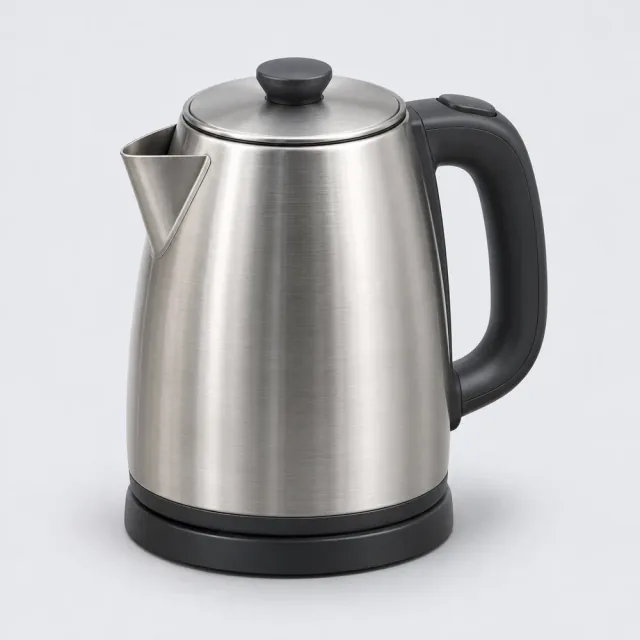
Some mugs and kettles use borosilicate glass, while other superficially similar products use soda-lime glass or a glass-ceramic. Laboratory glassware illustrates its thermal and chemical advantages but is not automatically suitable for food use. The right comparison is between specified products designed for a task, not between appearances.
Useful, with limits.
Thermal-shock resistance is not immunity to sudden temperature change. Shape, wall thickness, surface damage and the size of the temperature difference all matter. Different borosilicate families have different chemical durability. Follow the product manufacturer’s use limits rather than transferring a laboratory datasheet or a generic material claim to a household item.
A next life depends on the system.
Ordinary bottle-glass collection commonly excludes borosilicate because it behaves differently in a furnace. A local authority or specialist processor may offer another route, but availability is regional. An intact, appropriate vessel can be reused; a damaged one should not be trusted merely because its glass type is heat-resistant. Keep ceramics and specialized glass out of incompatible streams.
Familiar things, connected.

Follow the evidence
Original explanations informed by the sources below. Technical and industry sources support material behaviour; industry environmental marketing is not treated as a universal comparison. Read our editorial method.
- Borosilicate Glass ↗SCHOTT · Undated · Checked 2026-11-13
- Types of Technical Glasses ↗SCHOTT · Undated · Checked 2026-11-13
- Borosilicate glass: recycling guidance ↗North London Waste Authority · Undated · Checked 2026-11-13